How to manage a fish-duck polyculture pond? Key points of a green and innovative farming model
In fish-duck polyculture, substances in the water are reasonably transformed, maintaining a virtuous cycle. Ducks moving about in the water can cool down and refresh themselves and grow healthily, while the fish can utilize the waste excreted by the ducks and keep the water body clean. Fish-duck polyculture requires strengthened farming management, and only then will it bring high benefits.
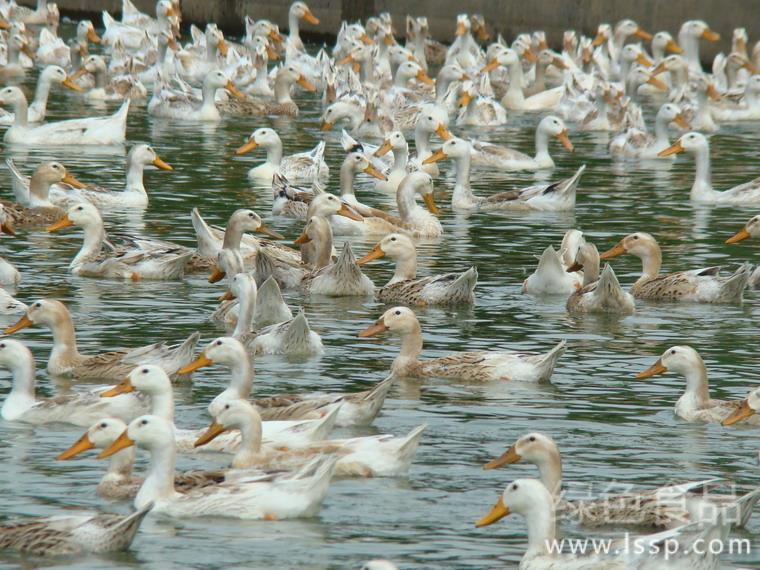
Fish-duck
1. Regulating water quality.Due to the activity of the ducks, the water in a fish-duck polyculture pond often evaporates considerably, and with the addition of duck droppings and residual feed, the water quality easily deteriorates. Therefore, in a fish-duck polyculture pond, water should be added and changed frequently, keeping the water depth at more than 1.2 m and keeping the water level as stable as possible, not fluctuating up and down. In hot seasons, the number of water changes should be increased, preferably once a day, to prevent fish from oxygen deprivation, surfacing, and pond die-offs. If the water quality changes, new water should be added and changed immediately, and drugs such as oxygen enhancers and water quality conditioners can also be splashed on for temporary emergency treatment.
2. Feed feeding.Duck feed should be fed on schedule under normal circumstances, and if necessary, an extra feeding can be given at night to prevent hunger. Do not feed too much feed, to prevent overfeeding and increasing the burden on the ducks' digestive system. The amount of fish feed fed can be appropriately determined according to the number of fish in the pond. Ponds with few fish do not need extra fish bait, as the duck droppings and residual feed in the pond are sufficient; ponds with many fish should adhere to the four-fixed feeding principle, appropriately add artificial feed, and randomly adjust the feeding amount according to weather conditions, with the principle of leaving no leftovers.
3. Duck droppings entering the pond.The duck house and duck yard should be cleaned on schedule every day. The amount of duck droppings entering the pond is determined by how fertile or lean the pond water is. In principle, the residual feed of the ducks can be directly swept into the pond for the fish to eat, and the excess duck droppings should be piled up for fermentation and applied as appropriate. Only in this way can the environmental hygiene of the fish-duck polyculture pond be maintained, and the water body not be polluted.
4. Disease prevention and control.Every 15 days, the water body should be disinfected and sterilized with quicklime, bleaching powder, etc. The duck house and duck yard should be kept dry and cleaned frequently. When feeding, drugs such as fleroxacin, avian antibacterial powder, and gentamicin can be added irregularly and mixed into the bait for feeding, which can effectively prevent the occurrence of diseases. If abnormal conditions such as fish diseases and duck diseases are found, diagnosis and treatment should be carried out immediately, with the right medicine for the illness. Dead fish, diseased fish, and dead ducks should all be promptly removed from the polyculture pond and buried deep away from the water surface to prevent the spread of pathogens.
5. Strengthen pond patrols.In a fish-duck polyculture pond, pond patrols should be maintained, especially when fish diseases and duck diseases are highly prevalent and during high temperatures, and two patrols must be kept, in the morning and evening. Their main purposes are: to observe the water color and water quality, and according to the observations, adjust the feeding and pond-entry amounts of feed and duck droppings, and maintain the frequency and interval of adding and changing new water; to observe the activity of the fish and ducks, and immediately solve any problems found; and to promptly remove residual feed and floating debris on the water surface, ensuring good water quality.