How to manage the green rice-fish farming model well
"Rice-fish farming" not only requires little investment, but also brings abundant grain, fat fish, ecological benefits and income. At present, there are rice-fish farming demonstration sites in many regions of our country. To help farmers better understand rice-fish farming, the key technical points of rice-fish farming are briefly introduced below for reference.
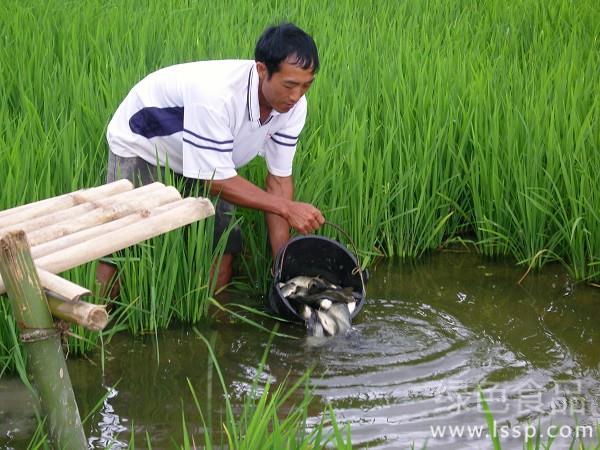
Rice-fish farming
I. Field selection:Choose rice fields with clean water quality, sufficient water sources, convenient irrigation and drainage, good water and fertilizer retention, and no impact from drought or flooding.
II. Field engineering facilities:
(1) Dig fish ditches and fish pits. During the rice growing period, the water level must be adjusted frequently, balancing dry and wet conditions. Shallow irrigation and field drying of rice fields are important technical measures for high-yield rice cultivation. To resolve the conflict over water use for fish in rice fields, fish ditches and fish pits must be dug before transplanting rice seedlings, increasing the water-holding capacity of the rice field and benefiting fish growth, rice fertilization and pesticide application. Fish ditches: a depth of 50-80 cm and a width of 50-100 cm is suitable. Fish ditches and fish pits must be connected. The number and arrangement of fish ditches are determined according to the shape and size of the rice field, and generally they can be in the shape of a "cross", "well" or "field" character. Each ditch should be straight, which is conducive to drainage, ventilation and light penetration. Fish pits: dig at the corner or in the center of the field, with a depth of 1-1.5 m, accounting for 5-8% of the rice field area. The shape can be rectangular, square or circular.
(2) Raise and reinforce the field ridges. Before transplanting rice seedlings, rice fields for fish farming should, in conjunction with digging fish ditches and fish pits, have the field ridges raised to 50-70 cm, widened to 40-50 cm, and beaten solid to ensure they will not leak or collapse.
(3) Install fish-blocking facilities at the inlet and outlet. The inlet and outlet of rice fields for fish farming should be opened at opposite corners of the rice field, and fish-blocking screens should be installed, made of bamboo strips or nylon netting, etc.
III. Fish stocking:In rice-fish farming, generally 7-15 days after rice transplanting, after the seedlings turn green, fish stocking begins, mainly with grass carp, common carp and crucian carp. Large-sized fingerlings of 50-100 g each are preferable, and 10-20 kg per mu is suitable. Before the fingerlings are put into the field, they can be soaked in 3%-5% salt water for 3-5 minutes to disinfect the fish bodies.
Rice-fish farming
IV. Feeding management :
(1) Artificial feeding. Rice field water is shallow and natural food is limited. To improve fish quality and yield, artificial feeding is necessary, such as rapeseed meal, bran, compound feed, etc. Feeding should follow the principle of "fixed time, fixed location, fixed quality, fixed quantity".
(2) Water management. In the early stage of rice growth, the water level should be kept at 3-5 cm so that the rice turns green as early as possible. In the middle and late stages of rice growth, the water level in the rice field should be kept at about 15 cm.
(3) Daily management. The key to rice-fish farming lies in preventing leakage and preventing fish from escaping. Therefore, the field ridges must be inspected frequently and the fish-blocking nets and screens checked. Especially on rainy days, drainage should be timely, and debris blocking the screens should be removed to facilitate smooth drainage and water filling. In rice fields, field mice and rice-field eels both dig holes in the field ridges, causing water leakage and fish escape, so careful inspection and timely plugging are necessary.
(4) Field fertilization management. To solve the harm caused to fish when fertilizing rice, the sectional interval fertilization method can be used. That is, one rice field is divided into two parts for fertilization, with an interval of about 2 days between them. Organic fertilizer should be the main type, with chemical fertilizer as a supplement; second, apply heavy base fertilizer and light topdressing.
(5) For pesticides, choose highly efficient, low-toxicity, low-residue, broad-spectrum pesticides, and prohibit pesticides highly toxic to fish. Pesticides should be sprayed on the rice seedlings as much as possible, applied on sunny days, and never applied before rain.