Key farming points for South American prawns affected by high temperatures in midsummer: feeding and molting
In the hot midsummer season, hot weather, strong sunlight, high water temperature, and poor water quality affect prawn feeding and molting, causing prawns to become diseased and die. Key points for South American prawn farming in midsummer:
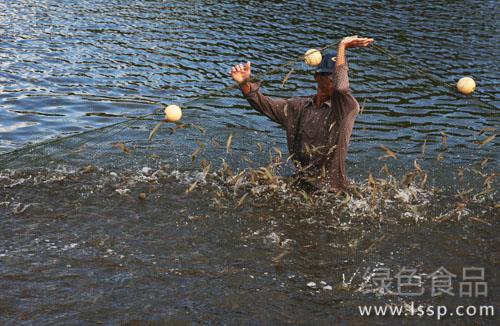
Prawn farming
1. Control temperature and regulate oxygen through water.
As water temperature rises and prawns grow, water depth should be continuously increased. Especially in the middle and late stages of prawn farming, the water level must be increased to 1.8-2 m, and during the high-temperature period it should remain above 2.2 m. For this reason, during spring tides, water should be drained once a day; during neap tides and dry periods, mechanical drainage and irrigation should be used, with about 50% of the water exchanged daily. During the high-temperature period, complete drainage and complete irrigation can effectively keep the water temperature within 30°C, pond water transparency at 35 cm, and dissolved oxygen at about 5 mg/L, so prawns feed vigorously and grow quickly, giving high quality and high yield. However, when changing water, prevent the introduction of tiny living organisms carrying viruses of explosive prawn epidemics; it is best to install a 60-mesh screen at the water inlet to filter the water.
2. Feed scientifically in stages.
When prawns grow to more than 4 cm, mainly feed low-value small shellfish bait such as snails and clams, feeding 6-8 kg per 10,000 prawns per day; at a body length of 8 cm, feed 50 kg per 10,000 prawns per day; at a body length of 12 cm, feed 100 kg per 10,000 prawns per day. If small shellfish bait is insufficient, compound feed can be fed. At a body length of 4 cm, feed 1.5 kg per 10,000 prawns per day; afterward, for each additional 0.5 cm increase in body length, increase the feeding amount by 0.3-0.5 kg; at a body length of 10 cm, increase it by 0.7-0.8 kg. If using ice-fresh small trash fish, 1 kg of compound feed is equivalent to 2.5 kg of ice-fresh small trash fish. Prawns hide by day and come out at night, are active frequently at night, and have a strong appetite; by day they hide and their appetite weakens. Therefore, feed before sunrise and after sunset, feeding 1/3 in the morning and 2/3 in the evening. Feed should be placed on platforms around the prawn pond so that all prawns can eat it. When feeding, adhere to the "four less, four more" principle: feed less in the early stage and more in the later stage; feed less in the morning and more in the evening; feed less at neap tide and more at spring tide; feed less when prawns molt in large numbers and more during normal growth. "Two no-feeding" rules: do not feed spoiled bait, and do not feed in ring ditches and deep water.
3. Guard carefully against prawn diseases.
In the hot midsummer season, prawns have poor appetite and activity, their metabolic level declines, and in addition pond water deteriorates and pathogenic organisms breed, easily causing prawn diseases. For this reason, first, the amount of prawn bait should not be too much or too concentrated, so as to avoid bait spoilage and water quality pollution. Especially for fresh live bait, in hot weather it spoils very easily, and prawns are prone to poisoning and death. To reduce water quality pollution, change water frequently. Second, pay attention to low-density culture. In the hot midsummer season, reasonably adjust prawn density so that prawns have a certain volume of water for activity.
4. Prevent prawns from surfacing for air.
At midnight and before dawn, oxygen in the pond is low, and this is the time when prawns are most likely to surface for air. If mysid shrimp and white shrimp are found surfacing for air, and small trash fish gather toward the pond edge, promptly start the aerator or continuously change water to increase the dissolved oxygen content in the pond. Usually, it is also necessary to frequently remove sludge and debris from the prawn pond to ensure fresh and good water quality, so as to prevent prawns from surfacing for air.