Key techniques for rapid fattening of young rabbits: scientific feed blending, small frequent meals, and disease prevention
I. Grouping and penning for fattening
According to the young rabbits' physical condition (strong or weak) and age in days, group young rabbits with similar weaning dates or similar growth and development, with 20-50 rabbits per group and 1-1.5 rabbits per sq m; when raised in cages, 3-4 per cage, as too much crowding affects the development of young rabbits.
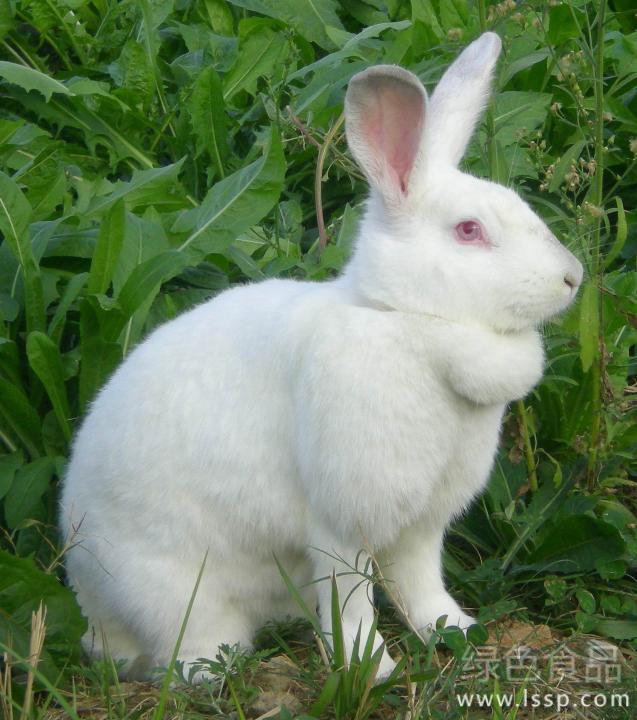
Rabbit
II. Three-stage fattening method for rabbits
The first stage focuses on concentrated feed, supplemented by green and coarse feed (rapid growth, building a larger frame); the second stage focuses on green and coarse feed, supplemented by concentrated feed (increasing feed intake, exercising digestive function); the third stage focuses on concentrated feed, supplemented by green and coarse feed (the purpose being rapid fattening).
III. Scientific feed blending
The feed for young rabbits should have a small volume, high nutritional value, be easy to digest, and must meet the standard for crude fiber. The most suitable fattening feeds for young rabbits include corn, oats, barley, wheat bran, soybean cake, potato, sweet potato, and so on. Reference formulas: for the early fattening stage, 70% green hay meal, 11% cornmeal (flour), 5% soybean cake, 10% wheat bran, 3% bone meal, 1% salt; for the late fattening stage, 10% green hay meal, 80% cornmeal (flour), 6% wheat bran, 3% bone meal, 1% salt. Feed more highly nutritious, easy-to-digest concentrated feed and succulent green feed such as bean vines and dandelion, and appropriately supplement with animal-based feed. The feed must be clean and fresh, and the feeding amount should gradually increase as the young rabbits grow older in months, to prevent sudden increases or changes in feed.
IV. Ensure small frequent meals
The daily feeding amount should be just enough for the young rabbits to basically eat their fill. When feeding, give small frequent meals, feeding 4 times a day, namely morning, noon, evening, and 22:00 (10 p.m.); drinking water is best provided by an automatic drinker or a self-flowing bottle; the temperature should be 5-25°C. Light exposure should be increased in the early stage, and in the late stage (especially 15 days before slaughter) the light should be dim.
V. Pay attention to environmental control
Place the young rabbits' cages and housing in a sunny, wind-sheltered, dry place where they can receive sunlight but not be exposed to direct blazing sun. When raised indoors in winter, keep the temperature at 5-10°C. Maintain good hygiene indoors and in the rabbit housing, insist on cleaning every day, change the bedding straw frequently, and keep it dry.
In summer, when temperatures are high, a shade shed can be built outside the rabbit housing or vine plants such as grapes, loofah, and pumpkin can be grown for shade, and methods such as opening doors and windows, splashing water, spraying, and turning on electric fans can be used to cool things down.
Keep the rabbit housing clean and dry, with relative humidity below 60%; when it is too damp, scatter chopped dry grass, sandy soil, quicklime, or plant ash, etc., to absorb moisture and disinfect and sterilize. For caged rabbits, release them 2-3 times a week during the cool morning and evening hours for exercise, but the time should not be too long (a dedicated person must supervise). In summer, feed during the cool morning and evening hours, provide clean and hygienic drinking water, and add 1-1.5% salt to the water.
Young rabbit
VI. Prevent diseases early
Add diaveridine to the feed of 25-35-day-old young rabbits, feeding each rabbit 1 mg per day; add chlorobenzoguanide to the feed of 36-45-day-old young rabbits, feeding each rabbit twice a day, 1 tablet each time; add quizalofop-ethanol to the feed of 46-55-day-old rabbits, feeding each rabbit twice a day, 1 tablet each time; each 60-70-day-old rabbit must be injected subcutaneously in the neck with 1.5 ml of rabbit plague vaccine. Observe the health of the rabbit herd, and when sick rabbits are found, isolate and treat them promptly. In summer, eliminate rodents, mosquitoes, and flies, prohibit feeding moldy feed, regularly vaccinate against rabbit plague and other immunizations, and strictly prevent infectious diseases.