Breeding goose feeding technology: key points on temperature, light, ventilation and feed feeding
Feeding and management goals for breeding geese during the laying period: strong physique, high and stable production, high fertility and hatchability of breeding eggs, completion of seed production and breeding tasks, and good technical indicators and economic benefits.
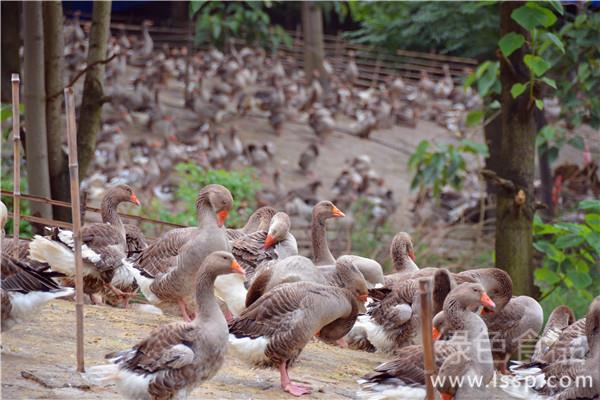
Breeding geese
1. Nutritional requirements and compound feed.Because breeding geese consume excessive nutrients, especially energy, protein, calcium, phosphorus, etc., for continuous egg laying and reproducing offspring, the level and balance of feed nutrition directly affect the production performance of female geese. Laying feed is started about 20 days before the breeding geese begin laying and mating. Because goose raising in China is mainly extensive, with grazing predominant in the south, the housed diet is only a supplement. Therefore, feed should be formulated according to local feed resources and the nutritional requirements of geese at each growth and production stage.
2. For breeding geese raised mainly under housed conditions,the recommended dietary nutrient levels are 10.88 kJ to 12.3 kJ/kg metabolizable energy, 14% to 16% crude protein, 5% to 8% crude fiber (not higher than 10%), 0.8% lysine, 0.35% methionine, 0.27% cystine, 2.25% calcium, 0.3% available phosphorus, and 0.5% salt. According to experiments, feeding breeding geese a compound feed made in the proportions of 40% corn, 12% soybean cake, 25% rice bran, 5% rapeseed cake, 1% bone meal, and 7% shell powder increased average egg production, fertilized eggs, and breeding egg fertility rate by 3.1%, 3.5%, and 2% respectively compared with feeding a single type of paddy rice.
3. In addition, goose raising practices in China and abroad have shown that feeding green, juicy forage helps improve the reproductive performance of female geese. Therefore, where conditions permit, more green forage can be fed during the breeding period of breeding geese.
4. Suitable ambient temperature.Physiological characteristics of geese: full down and feathers, with a relatively high down content; subcutaneous fat is present, but there is no sebaceous gland, and there is a well-developed uropygial gland, making heat dissipation difficult, so geese tolerate cold but not heat and are sensitive to high temperatures. In summer, when temperatures are high, geese often stop laying, and ganders' sperm lose vitality. When managing laying geese, attention should be paid to temperature, and heat protection and cooling measures should be taken in summer.
5. Suitable light duration.Both light intensity and duration affect the reproductive capacity of breeding geese. At suitable temperatures, increasing light for geese can raise egg production. Natural light plus artificial light should total no less than 15 hours per day, usually 16 to 17 hours, until the end of laying. At present, many breeding goose operations use open-sided goose houses and natural lighting systems, and insufficient light duration affects laying in breeding geese. Therefore, to increase the laying rate, light should be supplemented, starting 1 month before the onset of laying, increasing gradually from less to more until the suitable light duration is reached. Artificial lighting time should be increased in the morning and evening respectively. Different breeds of breeding geese require different light in different seasons, so a lighting plan should be made according to season, region, breed, natural light, and laying week age, and implemented according to the plan without arbitrary adjustment.
6. Reasonable ventilation and air exchange.During the laying period, breeding geese graze less and spend more time inside the goose house, and their food intake and excretion increase, which fouls the air inside the house and reduces oxygen, affecting goose health and causing a decline in egg production. To keep the air inside the goose house fresh, in addition to controlling stocking density (1.3 to 1.6 birds per sq m under housed conditions, 2 birds per sq m under grazing conditions) and promptly removing manure and litter, doors and windows should often be opened for ventilation.