River crabs are highly secretive and have a strong escape instinct; how to catch river crabs about to be harvested
I. Lower the water level and dig pits for harvesting:This method is suitable for intensive pond culture. Lower the water level of the crab pond by 40-50 cm, and dig a pit at each of the four corners of the anti-escape wall along the pond edge, each with a diameter of 40-50 cm and a depth of 50-60 cm. The inner walls of the pits must be smooth (or bury jars in the pond, with the jar mouth lower than the pond edge). At night, because the water level has dropped, the river crabs quickly come ashore and crawl along the anti-escape wall around the perimeter, stray into the pits, and are caught because they cannot escape.
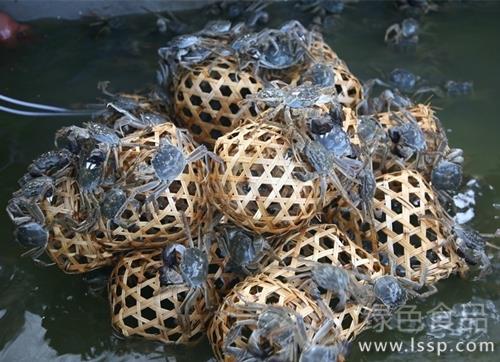
River crab harvesting
II. Dry-wet alternating harvesting:This method is suitable for intensive pond culture and rice-field culture. During the day, river crabs hide in the pond; at night, they crawl ashore one after another. Based on this characteristic, add water during the day and drain the water at night, letting the river crabs crawl into the pits around the anti-escape wall to be caught.
III. Silk net harvesting:Suitable for various large water-surface culture operations. Sink the silk net to the bottom. After the river crabs mature, they crawl in the water, and as soon as they touch the silk net, they are caught.
IV. Water-flushing harvesting:Suitable for intensive pond culture and rice-field culture. First lower the water level to 30-40 cm, then at night open the inlet valve and drainage valve at the same time so that the inflow and outflow are about equal. The river crabs swim upstream against the fresh water. Stretch nets or dig traps at the water inlet, and 90% of the river crabs can be caught.
V. Ground cage harvesting:Suitable for harvesting in large water bodies with dense and deep aquatic plants. How to make a ground cage: use polyethylene rope and netting to make a long tubular net bag 10-30 m long with a mouth diameter of 0.3 m. Inside the net bag, at intervals of 0.5 m, use aluminum wire to make square frames and place them in the net to prop up the net bag as ribs. Between each pair of ribs, cut and weave a hole on each of the two opposite sides, and inside the hole make a funnel inclined toward the inside of the net bag. Once a river crab enters the inclined funnel in the hole, it can enter but cannot retreat. When catching river crabs, place one end of this ground cage inside the enclosure net and sink the other end to the pond bottom. When river crabs pass by the ground cage, their path is blocked; when they encounter the cage opening, they crawl into the ground cage.
VI. Crab fence harvesting:Split moso bamboo into strips about 3 m long, 0.5 cm wide, and 0.3 cm thick, and weave them into a screen with fine palm rope. Place the moso bamboo screen in the water to form a barrier cross-section. When river crabs pass by, they crawl along the fence screen. When a river crab crawls to the top of the fence, there is a funnel-shaped inclined opening; once the river crab enters, it cannot get out.
VII. Crab lift-net catching method:Take 2 strips of moso bamboo (each strip 80 cm long, 1.5 cm wide, and 0.5 cm thick) and cross them in a cross shape. At the crossing point, tie them firmly with a rope more than 1.5 m long, and attach a float to the other end. Tie a lift net to the ends of the two bamboo strips. A square net bag 30-50 cm across is best for the lift net. Tie a piece of fish meat or animal offal in the center of the lift net, place the lift net in deep water, and lift it to catch once every hour.
VIII. Straw rope smoking method:Suitable for harvesting in long water surfaces or river ditches. Twist straw into rope 4 cm in diameter, smoke this rope over burning dry straw for 3-4 hours, then place it in the water with both ends on the bank. River crabs are sensitive to smoked rope. When they crawl near the rope, they will never crawl over it, but crawl along the rope in one direction to the bank. Bury a hidden pit or net bag at one end on the bank, and the crabs stray into it and are caught.