Shrimp Feed Feeding Amount and Methods: Reasonable Feeding Promotes Shrimp Growth
Feed is the material basis for farming shrimp and for shrimp growth, so feeding must be done reasonably according to the feeding habits of the shrimp. So-called reasonable feeding means precise feeding according to the physiological needs of the shrimp at different growth stages and their living state at the time.
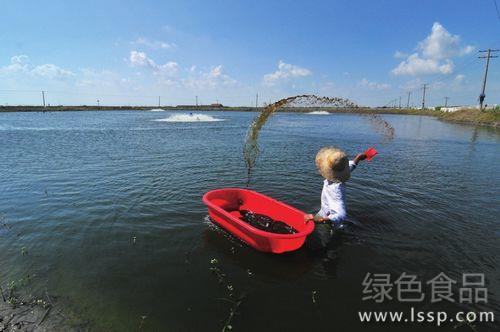
Shrimp feeding
(1) Daily feeding amount:
1. Regularly estimate the survival quantity of shrimp in the shrimp pond.
It is very difficult to accurately estimate the survival quantity of shrimp in a pond. Because shrimp are unevenly distributed in the pond and swim continuously in groups, estimation of the survival quantity of shrimp in a shrimp pond is generally carried out by experienced shrimp farmers using visual estimation, frame net determination, trawl net determination, and cast net determination.
2. Calculate the actual daily feeding amount.
Based on the estimated number of shrimp and average body length, calculate the actual daily feeding amount by referring to the shrimp feeding amount table, but adjust it at any time according to actual conditions.
3. Adjust the feeding amount.
(1) Adjust according to feeding speed. If 1.5 hours after feeding more than 70% of the shrimp have half-full or full stomachs and the shrimp group is not foraging, this indicates the feeding amount is appropriate. If the feed put in is quickly eaten up, large numbers of shrimp are swimming, and empty stomachs and residual stomachs exceed 30%, this indicates insufficient feeding. Conversely, if there is leftover feed, this indicates excessive feeding and it should be appropriately reduced.
(2) Adjust according to shrimp growth. Generally speaking, in the early stage of shrimp farming, shrimp increase by an average of 0.13-0.16cm per day; in the middle stage 0.08-0.10cm ; in the late stage 0.06-0.08cm . If the above standards are not reached, and there are no problems with the shrimp body or the water environment, the slow growth may be caused by insufficient feeding, and the feeding amount should be increased.
(3) Adjust according to the environment. Actual feeding should be appropriately adjusted according to weather, temperature, water quality, medication application, and other conditions. Feed less when the environment is poor .
Shrimp farming
(2) Feeding methods.
1. Feeding location. According to the shape of the shrimp pond, set up feeding areas or feeding strips, and avoid broadcasting feed over the whole pond. This is beneficial for shrimp perching and activity.
2. Feeding frequency and time. Flexibly manage according to season, weather, and shrimp body size. At the postlarval stage, feed 4 times per day, at 6 o'clock, 10 o'clock, 18 o'clock, and 2 o'clock, with each feeding amount accounting for 30%, 10% , 40%, and 20% of the total respectively; at the juvenile and adult shrimp stages, feed 3 times per day, at 5 o'clock, 19 o'clock, and 23 o'clock, with each feeding amount accounting for 40%, 45%, and 15% of the daily total respectively. In hot weather, feeding is not suitable from 10 a.m. to 6 p.m. Generally, the best feeding times are after sunset and before sunrise, namely 19 o'clock and 6 o'clock.
3. Feeding principles. Persist in frequent feeding and small feeding, and feed more in the evening and early morning; during mass molting, reduce or temporarily stop feeding, and then increase feeding again after one day; when the wind is gentle and the sun is warm and the weather is clear, feed more; when water quality is good, growth is slow, and there is no disease, feed more; when there are many food-competing organisms in the shrimp pond, feed more; do not feed spoiled, deteriorated, or inferior feed; feed when the water temperature exceeds 32°C; do not feed when water quality is poor; do not feed when strong winds and rainstorms are coming; do not feed when disease appears. During feeding, pay attention to weather changes. In overcast and rainy weather or when water quality is relatively poor, especially at high temperatures, the feeding amount should be controlled to reduce leftover feed, so as to prevent worsening of pond bottom pollution and prevent outbreaks of shrimp disease.