Four-stage management of meat-type breeding pigeons is crucial; poor rearing leads to degeneration and poor returns
The profitability of raising meat pigeons lies in raising breeding pigeons to produce squabs for the market, so whether breeding pigeons are raised well is the key to whether the meat pigeon industry can be profitable. Practice has shown that each pair of breeding pigeons produces 6 to 10 pairs of squabs per year, with an annual net profit of about 80 to 150 yuan. However, according to surveys, many pigeon raisers' returns do not reach the standard, because the introduced breeding pigeons are not of good reproductive condition or have degenerated severely, or are improperly raised. To raise meat-type breeding pigeons well, the "four stages" of management must be carried out properly.
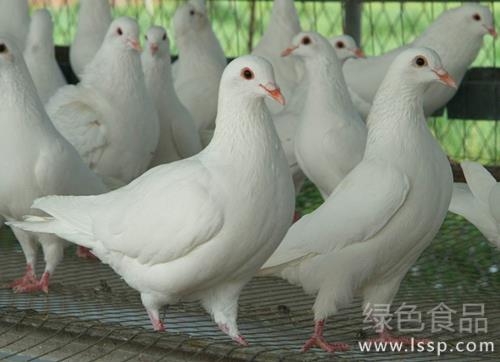
Meat pigeon
Pairing stage: meat pigeons are best paired at 6.5 months of age, and forced pairing is done at night. For pairing, select male and female pigeons of similar body type and weight and uniform feather color. If 4 eggs are laid after pairing, they are from the same mother. Those that often lay infertile eggs after pairing should be re-paired. For those that do not lay eggs after pairing, the male pigeon can be given an intramuscular injection of testosterone propionate at 5 mg per dose, with another injection 3 to 5 days later; or oral vitamin E, one capsule per bird. Those that often fight after pairing should also be re-paired, and after re-pairing, keep the two separated where they cannot see each other.
Incubation stage: meat pigeons begin laying eggs 10 to 15 days after pairing. Two days before laying, spread burlap pieces, short rice straw or pine needles in the nest. During incubation, prevent rain from entering; hatching eggs that become soaked or wet will die. Prevent the bedding from becoming dirty and wet; if it is dirty and wet, replace it promptly. Hatching eggs should not leave the parent pigeon's belly feathers. In hot weather, reduce the bedding, open more windows, and wash the floor with cool water or spray to lower the temperature; in cold weather, add bedding and pay attention to keeping warm, adding heat for warmth below 6°C. Candling should be done once each on the 5th and 12th days after incubation, and infertile eggs and dead embryo eggs should be removed promptly; on days 17 to 18, check the hatching situation, and for those having difficulty breaking out of the shell, assist manually by peeling the shell, peeling only 1/3 or less.
Brooding stage: give feed with higher nutrition, 18% protein, more than 2800 kcal/kg metabolizable energy, fed 5 to 6 times a day. Take good care of the squabs; single squabs should be merged into another nest. At 15 days of age, move the squabs onto the wire mesh at the bottom of the cage for rearing.
Molting stage: breeding pigeons molt once a year in late summer and early autumn, lasting about 1 to 2 months. At this time, increase hemp seed by 10% in the meat pigeon feed, add 200 g of gypsum powder or 100 g of sulfur powder per 50 kg of health sand, and add multivitamins, promptly cull meat-type breeding pigeons with poor production performance, and select replacements from the reserve breeding pigeon flock.