Technical key points for dry rearing of meat geese with environmental feed, feeding and management
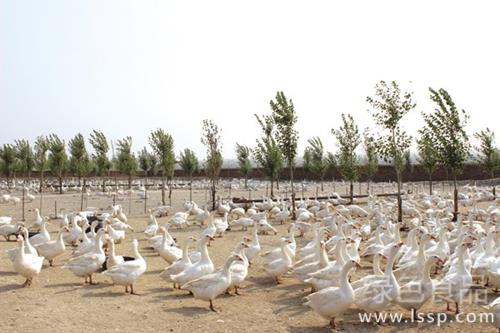
Meat geese
Environmental control:
1. Site selection. Do not occupy arable land; the terrain should be high and dry, open and neat; within a 1 km radius there should be no other poultry farms or slaughter and processing plants; keep away from main traffic roads, at least 1 km from residential areas, and at least 0.5 km from rivers; it should be conducive to sanitation and epidemic prevention and harmless treatment of waste; at the same time, there should be grassland or forage planting land matching the scale of meat goose rearing.
2. Layout arrangement. Isolation walls, nets or excavated epidemic prevention ditches should be set around the goose houses; the goose houses should be built in rows, with the long axis perpendicular to the prevailing wind direction in summer; spacing should be maintained between goose houses, and clean roads (for transporting feed, etc.) and dirty roads (for transporting manure, etc.) should be separated and must not cross.
Feeding methods:
1. Litter rearing. Choose suitable litter, such as chopped corn stalks, crushed rice husks, wheat straw, etc., which should be soft, dry and highly absorbent. The litter thickness is best at 4—5 cm, pressed tightly and compacted.
2. Raised-bed flat rearing. The bed height is 70—80 cm, and bamboo strips or wood strips can be arranged vertically (to increase compressive strength). During the brooding period, the gap spacing is 1—1.5 cm, and in the middle and later periods it is 2—2.5 cm.
3. Cage rearing. Although the cost is relatively high, it is convenient for cleaning and disinfection and can be used for a long time. Selecting iron bars and high-hardness iron wire for welding by oneself can reduce costs. Feed troughs and water troughs should be deep, and their height should be adjusted in time as the geese grow larger. Because it is not easy to feed green forage during cage rearing, benefit calculations should be done first.
Feed supply:
It is best to use compound feed. The diet should be mainly based on carbohydrate-rich feeds such as corn and broken rice, and supplemented with high-protein feeds such as soybean meal. The recommended nutritional reference standards are: at 1—20 days of age, metabolizable energy 11.70 MJ/kg, crude protein 20%, crude fiber 5%; at 21—40 days of age, metabolizable energy 11.29 MJ/kg, crude protein 16%, crude fiber 7%; at 41—70 days of age, metabolizable energy 11.91 MJ/kg, crude protein 18%, crude fiber 4.5%. For the supply ratio of green feed to concentrate feed, in the early stage (1—20 days of age) 1:1 is appropriate; in the middle stage (21—40 days of age) 1:1.5 is appropriate; in the later stage (41—70 days of age) 1:2 to 1:2.5 is appropriate. Because meat geese under cage rearing or raised-bed flat rearing are prone to soft leg disease, sufficient calcium and phosphorus need to be supplemented, with a calcium-to-phosphorus ratio of about 1:0.7.
Dry rearing of meat geese
Management key points:
1. Implement the "three separations" for pen rearing. It is appropriate to keep 25—30 meat geese per pen, with males and females, and strong and weak birds, raised separately.
2. Control lighting. Reduce lighting time and lower lighting intensity.
3. Restrict movement. Reduce the range of activity.
4. Reduce stress. For the same batch of meat geese, the rearing site and rearing personnel should be relatively fixed, and the number of outsiders should be controlled and noise reduced.
5. Sanitation and disinfection. Before the goslings enter the house, the pens, water and feed troughs and other supplies should first be thoroughly swept and cleaned, and the site should be disinfected with sodium hydroxide or fumigated with formalin. The water troughs should be cleaned every day. During the meat goose rearing process, disinfection with the geese present can be carried out. Before disinfection, first clean the goose house to improve the disinfection effect and save the amount of medicine used. Choose broad-spectrum, high-efficiency, low-toxicity and low-irritation disinfectants such as Baidusha, and disinfect the flock together with the site, 2—3 times a week. In summer, during periods of frequent disease or during heat stress, disinfect once a day.