Key Points for Fattening Thin Cattle in Winter, a Good Choice for Extra Income in the Farming Off-Season
The early winter climate is suitable and forage and feed are abundant, making it the best season for fattening thin cattle. Farmers with the means can take advantage of this favorable opportunity to buy back thin cattle that are about to be culled from the market and raise them carefully with rapid fattening. After fattening, they can be slaughtered and sold for double the profit, making this a good project for increasing income during the farming off-season.
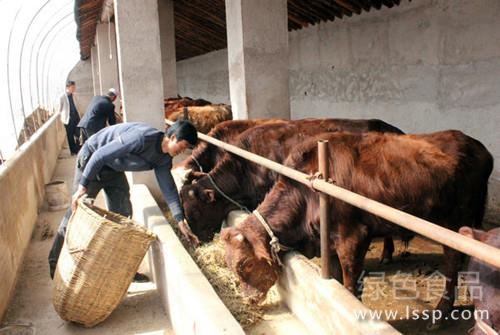
Fattening Thin Cattle
Reasons cattle become thin: first, excessive fatigue and high physical exertion; second, parasites in the body; third, disordered gastrointestinal digestive function and poor digestion and absorption; fourth, insufficient quantity and poor quality of forage, with incomplete nutrition. In response to these causes, fattening thin cattle can make use of the compensatory growth characteristic of cattle, that is, cattle whose growth slowed or stalled because of previous insufficient feed, poor nutrition or poor digestion and absorption will, once restored to a high nutritional level, gain weight and accumulate fat more rapidly, even faster than when they were not subjected to restricted feeding, and after a period of superior feeding they can still recover to normal body weight. Of course, such thin cattle must be healthy, have relatively complete teeth and have digestive capacity. Methods and steps for fattening thin cattle:
1. Stop work. After the cattle are bought back, let them rest fully and no longer use them for labor.
2. Deworming. Administer trichlorfon orally at 0.05 g per kg of body weight, given orally once, once a day, for two consecutive days. Or feed albendazole mixed into the feed at 2.5-10 mg per kg of body weight.
3. Stomach strengthening. Traditional Chinese medicine can be used to strengthen the spleen and stimulate appetite, or 400 g of tea leaves and 200 g of honeysuckle can be decocted into juice and fed to the cattle, or 3-4 kg of turmeric can be mixed with rice wine and fed to the cattle in 4 portions; or 75 g of Cyperus rotundus, 50 g of dried tangerine peel, 75 g of radish seed, 75 g of bitter orange, 75 g of Poria cocos, 100 g of hawthorn, 100 g of medicated leaven, 100 g of malt, 50 g of areca seed, 50 g of green tangerine peel, 50 g of Lindera aggregata and 50 g of licorice can be decocted in water and given orally once, one dose per head per day, for two consecutive days.
4. Fattening. Grazing fattening: when grazing is possible in the field, the grazing time should be extended as much as possible, about 12 hours per day; in safe places, night grazing or supplementary feeding can be done. Barn feeding fattening: if grazing is not possible, use barn feeding, carried out separately according to feed resources. (1) Cut green grass and feed it, along with bran and concentrate. (2) Feed distillers' grains or tofu residue. At the beginning of feeding, the cattle are not used to it, so they should be trained, increasing the amount from little to more. The distillers' grains or tofu residue fed to cattle should be fresh, and moldy or spoiled ones must not be used. If after feeding distillers' grains the cattle develop eczema, red and swollen knee joints or bloating, feeding of distillers' grains can be temporarily stopped. Tofu residue can be fed up to 35 kg. (3) Feed silage or ammoniated feed, 13-30 kg per head of cattle, along with concentrate, minerals and salt.
5. Precautions. No matter which fattening method is used, the feed should not be monotonous; it should be as varied as possible to improve palatability, and "drink first, then feed" and "coarse first, then fine" should be followed to encourage more intake. Forage formula: in the first 30 days, 75% green grass, 5% high-quality dry hay, 5% cornmeal, 10% soybean cake and 10% wheat bran, with an appropriate amount of salt; in the middle 30 days, 45% green grass, 15% high-quality dry hay, 20% cornmeal and sorghum meal, 15% soybean cake and 5% wheat bran, with an appropriate amount of salt. On the premise of keeping the barn dry, tie the cattle's nose rope appropriately short to limit the cattle's activity, so as to fatten early and bring to market early.