What is ammonium nitrogen fertilizer, and what are the common types?
What is ammonium nitrogen fertilizer? What types of ammonium nitrogen fertilizer are there? What properties do they have? We ask knowledgeable readers to help explain. Ammonium nitrogen fertilizer is a simple nitrogen fertilizer in the form of ammonium salts, and the more common types are ammonium bicarbonate, ammonium sulfate, and ammonium chloride. Zhongdi Network has compiled the properties of the above three ammonium nitrogen fertilizers, listed in detail below...
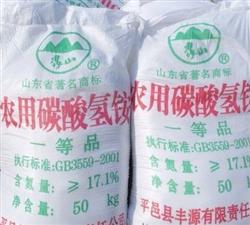 What is ammonium nitrogen fertilizer? What types of ammonium nitrogen fertilizer are there? What properties do they have? We ask knowledgeable readers to help explain.
Ammonium nitrogen fertilizer is a simple nitrogen fertilizer in the form of ammonium salts, and the more common types are ammonium bicarbonate, ammonium sulfate, and ammonium chloride. Zhongdi Network has compiled the properties of the above three ammonium nitrogen fertilizers, listed in detail below for readers' reference.
Characteristics of ammonium bicarbonate:
Ammonium bicarbonate generally contains about 17.7% nitrogen. It is colorless or white, decomposes easily at room temperature, and surfactants can be added to enlarge the ammonium bicarbonate granules. It leaves no acid radical residue, and long-term application does not affect soil quality, making it one of the safest nitrogen fertilizer varieties. Ammonium bicarbonate can be stored for a long time without caking, has a higher fertilizer effect than ordinary ammonium bicarbonate, and can also be used as a raw material for three-element compound fertilizer.
How to use ammonium bicarbonate:
The application of ammonium bicarbonate should follow the fertilization principles of not leaving the soil and not leaving water, and fertilizing the soil first and the seedlings later. That is, apply ammonium bicarbonate deep into the soil so that it does not leave the soil and water, is absorbed and held by soil particles, and continuously supplies nutrients to the crops. Ammonium bicarbonate can be applied as a base fertilizer by spreading and deep placement, and can also be used as a top dressing by furrow application and hole application.
Precautions for ammonium bicarbonate:
1. Ammonium bicarbonate should not be sprayed on leaves, as it easily burns the leaves.
2. Ammonium bicarbonate should not be applied to dry soil or at high temperatures.
3. Ammonium bicarbonate should not be mixed with alkaline fertilizers such as plant ash and lime.
4. Ammonium bicarbonate should not be mixed with bacterial fertilizer.
5. Ammonium bicarbonate should not be mixed with superphosphate and left overnight before use.
6. Ammonium bicarbonate should not be mixed with urea.
7. Ammonium bicarbonate should not be stored together with pesticides.
8. Ammonium bicarbonate should not be used as seed fertilizer.
Characteristics of ammonium sulfate:
Ammonium sulfate generally has a nitrogen content of about 20%-21% and a sulfur content of 25.6%. It is colorless crystals or white granules; off-colors indicate the presence of impurities. It is odorless, stable, and a physiologically acidic fertilizer with a quick fertilizer effect, suitable for general soils and crops.
How to use ammonium sulfate:
Ammonium sulfate can be used as base fertilizer, top dressing, and seed fertilizer. Deep application preserves fertilizer and helps crop absorption. Top dressing methods can include furrow application and hole application.
Precautions for ammonium sulfate:
1. When ammonium sulfate is used as seed fertilizer, control the amount to prevent burning the seeds.
2. In soil, ammonium sulfate and calcium carbonate easily produce calcium sulfate, and long-term use can lead to soil compaction.
3. In strongly reducing soil, ammonium sulfate can be reduced to hydrogen sulfide, especially in the later stages of crop growth, easily poisoning old roots.
Characteristics of ammonium chloride:
Ammonium chloride generally has a nitrogen content of about 24%-25%. It is a colorless or white crystalline powder, odorless, strongly hygroscopic, easily caking, and easily soluble. It is a physiologically acidic fertilizer with a rapid fertilizer effect, and its mechanism of action is similar to that of ammonium sulfate. The chloride radical can inhibit nitrification and promote the crop's absorption of minerals, but chloride ions easily form hydrochloric acid, and in neutral or calcareous soil they react with soil colloids to produce calcium chloride, causing the quality of soil colloids to decline.
How to use ammonium chloride:
Ammonium chloride can be used as base fertilizer and top dressing, but cannot be used as seed fertilizer. It can be applied to crops such as wheat, rice, corn, and rapeseed, and especially has the effect of enhancing fiber toughness and tensile strength and improving quality in cotton and hemp crops. Its application effect in paddy fields is even better than that of ammonium sulfate.
Precautions for ammonium chloride:
1. Ammonium chloride cannot be applied together with alkaline chemical fertilizers, and it is best not to apply it in saline soil.
2. It must not be applied in large amounts to chlorine-sensitive crops such as tobacco, sugarcane, potato, flax, tea, and sweet potato.
What are the common nitrogen fertilizers?
What are the functions of magnesium fertilizer?