Why do laying ducks tend to produce low yields in winter? Low temperatures and poor feed - four breeding measures to help achieve high yields
In winter, temperatures are low, feed is scarce and breeding conditions are poor, so the laying rate of ducks declines. But with careful management and by creating a suitable environment for the laying ducks, high yields can still be achieved. Skillful winter management of laying ducks is mainly reflected in four aspects:
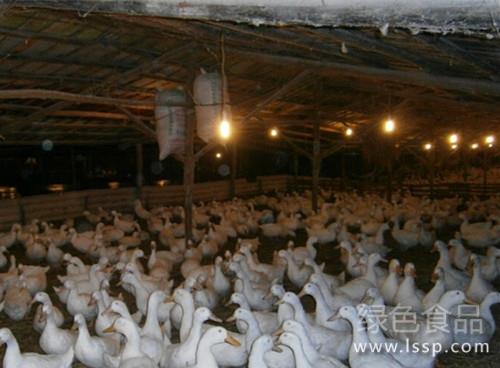
Lighting for laying ducks
1. Cold protection and warmth.Temperature is crucial to the egg production of laying ducks. The most suitable temperature during the laying period is 13-22°C. Cold protection and warmth are needed to ensure the ducks are not affected by cold waves, and the laying rate generally still remains at about 85%. Measures for cold protection and warmth in the duck house: reasonable construction - build the duck house in a dry, wind-sheltered and sunny place; seal doors and windows, preferably nailing plastic film over the windows and hanging straw curtains at the entrance; frequently add dry straw, which should be fine and soft and appropriately shortened; the straw at the bottom need not be removed, as this can increase the comfort of the laying ducks when lying down, and fermentation of the bottom straw can generate heat; give the laying ducks warm water, not cold water, and certainly not water with ice bits; use artificial heating inside the house to supplement heat, but pay attention to safety to prevent fires, poisoning and burns.
2. Increase nutrition.In winter, most of the energy of laying ducks is used to resist the cold. To ensure energy supply, energy feed should be appropriately added to the daily ration. Generally, the metabolizable energy per kilogram of daily ration should reach 2.7-2.8 megacalories, and it is best to add 3-5% oil to the feed. At the same time, attention should be paid to increasing protein feed to maintain a suitable energy-to-protein ratio. The crude protein content per kilogram of daily ration should reach 16-18%. In addition, the amino acid ratio should also be appropriate, requiring a methionine content of 0.3%, lysine 0.7% and cystine 0.55%. In winter, green feed is scarce. If the vitamin supply is insufficient, it easily affects the physique of the laying ducks and further affects the laying rate. Feeding feed such as cabbage leaves, shredded radish, shredded carrot, grain sprouts and malt can all supplement vitamins well.
3. Increase lighting.Lighting also affects the laying rate of ducks. Light stimulation can promote follicle development and ovulation. In winter, the lighting time is short, and the laying rate of ducks is greatly affected. Timely supplementary lighting can effectively increase the egg production of laying ducks. Experiments have shown that duck flocks given appropriate supplementary artificial lighting lay 20-25% more eggs than flocks without supplementary lighting. More light bulbs can be installed in the duck house. Generally, one 40-60 watt bulb is installed per 10 square meters, and the bulb should be 1.2-1.5 m above the ground. To increase light utilization, the bulbs should be fitted with lampshades so that the light can be concentrated on the ground. Supplement lighting in the evening and morning respectively, that is, turn on the lights after sunset for 2-3 hours of lighting, and turn on the lights before dawn for 2-3 hours of lighting until daybreak. Ensure that the lighting time per day is about 16 hours.
4. Appropriate exercise.In winter, laying ducks are naturally inactive, and with the increased nutrient concentration of the feed, they easily become too fat, affecting the laying rate, so strengthening exercise is very important. To encourage the duck flock to move, at noon when sunlight is sufficient, the ducks should be driven outside the house for exercise; in cold or other unfavorable weather, when the duck flock is not suitable for going outdoors, the ducks can be driven inside the duck house to encourage slow movement, generally 4-5 times a day. Outdoor activity can be combined with releasing them into water, which both exercises them and allows the flock to feed freely, improving the laying rate, but the time and frequency of water release should be controlled according to weather characteristics: on sunny days, release them into water from 10 a.m. to 2 p.m.; on cloudy days, the water release time should be appropriately shortened; in windy, rainy, snowy or heavy frost and foggy weather, water release may be omitted; after freezing, stop releasing them into water.