How to treat fish mad-swimming disease with targeted remedies? Multiple diseases can easily cause fish to swim wildly
Fish have some parasites parasitic on their body surface or inside their bodies, which makes the fish restless and swim wildly. Mad disease, Chinese anchor worm disease, fish louse disease, wheel worm disease, and gyrodactylosis have similar symptoms and basically the same epidemic season, so they are very easy to misdiagnose, delaying treatment and causing economic losses. The symptoms and control methods of these diseases are introduced below:
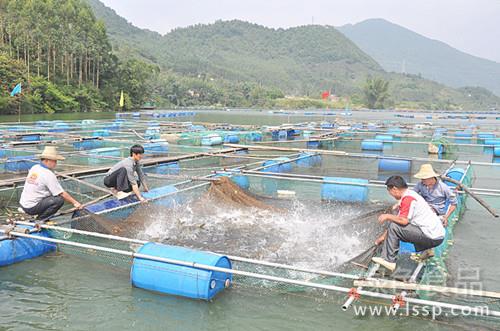
Fish farming
I. Mad disease.Symptoms: The fish swim wildly and dart about, spin in circles, lose balance, sometimes sink to the bottom, sometimes float to the surface, have a large head and thin body, with the tail extremely upturned, and sometimes abdominal dropsy. Control: (1) Disinfect each mu of fish pond with 125 kg of quicklime to kill the spores parasitic in the mud; regularly splash 2.5% trichlorfon powder, with a pond water concentration of 5×10E-6. (2) Splash 90% crystalline trichlorfon over the whole pond, with a pond water concentration of 0.5×10E-6, and combine with feeding rice bran soaked in 10×10E-6 dichlorvos (80% emulsion) or 10×10E-6 crystalline trichlorfon, feeding continuously for 3 days.
II. Chinese anchor worm disease.Symptoms: The fish are restless and swim wildly or turn in circles at the water surface, the upper lobe of the caudal fin is exposed above the water, and the ends of the gill filaments are swollen, inflamed and whitened and have many parasites attached, visible to the naked eye, shaped like small maggots. Control: (1) Splash a 5:2 mixture of copper sulfate and ferrous sulfate over the whole pond, making the pond water 0.7×10E-6. (2) Splash a mixture of 1.2:0.2 of 2.5% trichlorfon powder and ferrous sulfate over the whole pond, at a concentration of 1.4×10E-6.
III. Fish louse disease.Symptoms: The diseased fish are restless, swim wildly in the water, and leap out of the water; the parasites are the size of a grain of rice, light blue-gray, and visible to the naked eye. Control: (1) Bundle masson pine branches into bunches and place them in the water, using 20 kg per mu of water surface, which has a preventive effect. (2) Splash 90% crystalline trichlorfon over the whole pond, at 0.3×10E-6 to 0.5×10E-6. (3) Use 6 to 10 ml of deltamethrin per mu (water depth 1 m), with very good results.
IV. Wheel worm disease.Symptoms: The body surface of the diseased fish secretes a large amount of mucus, white patches appear on the fins, head, and body surface, and the fish swim wildly in groups along the pond edge. Control: (1) Use 5 to 20 kg of chinaberry leaves per mu to ret in the water, changing once every 7 to 10 days, or decoct fresh branches and leaves of chinaberry and splash the decoction over the whole pond. (2) Sprinkle a mixture of copper sulfate and ferrous sulfate over the whole pond (method as above). (3) Splash 50% amobam emulsion over the whole pond, with a pond water concentration of 0.5×10E-6, which has a special effect.
V. Gyrodactylosis.Symptoms: A light blue film appears on the body surface of the fish, and on careful observation of the body surface, fine hair-like parasites are moving. This causes extreme restlessness in the fish, sometimes swimming wildly, sometimes swimming on their sides. Control: Before stocking fish fingerlings, soak and wash them with 20×10E-6 potassium permanganate for 15 to 30 minutes.