Three points to note when raising pigs in a winter greenhouse: warmth and cold protection, and harmful gas prevention and control
Warmth: even during the "sanjiu" period, the daytime temperature inside the greenhouse can reach 18-20°C, and at night it stays above 0°C. This reduces the pigs' energy loss, speeds up weight gain, and lets the pigs keep putting on meat in winter as usual. But raising pigs in a greenhouse also requires attention to three points:
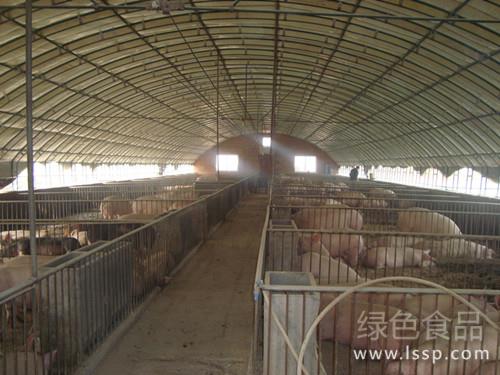
Raising pigs in a greenhouse
1. The warmth issue: although a greenhouse can retain heat, its insulation performance is poor. Because winter temperatures are low, sunshine is short, and the temperature difference between inside and outside the greenhouse is large, the plastic film easily forms condensation, and the warmth cannot be maintained for long.
Warmth retention measures: 1. At night, hang cotton quilts or straw curtains on the pen doors to prevent drafty wind from entering. 2. Check used plastic film for holes, patch up damaged parts well, and protect the plastic film in normal times. 3. At night, cover the ceiling plastic film with straw mats to enhance insulation performance. 4. If conditions permit, lay double-layer plastic film to improve the insulation effect. 5. Manage scientifically so the pigs form the habit of defecating and urinating at fixed spots, preventing the pigs from getting chilled by lying in urine. 6. Practice high-density rearing, keeping several more pigs in each pen to make full use of the pigs' own body heat. 7. Spread straw bedding on the pig house floor.
2. The moisture issue: the pigs live in a sealed greenhouse, eating, living, and defecating inside it; added to water splashed from the troughs, the moisture is hard to evaporate, the greenhouse becomes damp, and this affects warming. When the weather is cold, the higher the humidity in the greenhouse, the colder the pigs feel.
Moisture control measures: 1. Ventilate every day according to the weather; generally, when the temperature is high from 10 a.m. to 2 p.m., open the skylights and ventilation holes, ventilating for 0.5-1 hour each time. When the weather is clear and fine, ventilate a little longer; on cloudy days, ventilate for a shorter time. 2. If conditions permit, install air conditioners and blowers to regulate humidity. 3. Change the bedding frequently to help remove dampness and keep the floor from being wet; furnace ash and dry soil that absorb water can also be spread in the pig house. 4. Promptly wipe the water droplets on the film with a highly absorbent cloth, or catch them with buckets and pour them out at once, to reduce humidity in the greenhouse. 5. Cement floors should have a certain slope so manure and urine can flow into the urine pit, and these should be removed promptly.
3. The harmful gas issue: pigs breathe and excrete manure and urine, and feed and bedding ferment, producing harmful gases such as ammonia, hydrogen sulfide, and carbon dioxide. If the content is too high, it easily causes disease and poisoning in pigs.
Measures against harmful gases: 1. Open the skylights and ventilation holes on schedule every day to discharge harmful gases and bring in fresh air. 2. Pig manure and urine are the most important source of harmful gases, so they must be cleared once each in the morning, at noon, and in the afternoon every day to keep the floor sanitary and dry. 3. Strengthen the management of feeding utensils; the feed troughs, mixing troughs, and water troughs used for feeding pigs should be regularly scalded with boiling water and scrubbed clean. Make sure no feed is left over at each meal, to prevent leftover feed from souring and molding and producing harmful gases. At the same time, feeding utensils and tools should be used separately, and regular and irregular disinfection of feeding utensils, tools, and the environment should also be done well, to eliminate the rotten smell of metabolic waste, ensure ventilation and fresh air, improve the pigs' disease resistance, and guarantee the health of the live pigs.