Why must farmyard manure be composted before it can be applied?
Why must farmyard manure be composted before it can be applied? Please provide an introduction and composting methods. Many farmers have asked why farmyard manure needs to be composted before it can be applied. Therefore, Zhongdi Network has compiled the harms of applying uncomposted farmyard manure and the operating methods for composting. The following is a detailed list for netizens' reference. Farmyard...
 Why must farmyard manure be composted before it can be applied? Please provide an introduction and composting methods
Many farmers have asked why farmyard manure needs to be composted before it can be applied. Therefore, Zhongdi Network has compiled the harms of applying uncomposted farmyard manure and the operating methods for composting. The following is a detailed list for netizens' reference.
Harms of applying uncomposted farmyard manure:
Hazard one,Uncomposted farmyard manure often contains large amounts of pathogens and insect eggs, which can easily cause root diseases and pests in fruit trees, and can also pollute the environment;
Hazard two,The nutrients in uncomposted farmyard manure are mostly in organic form, which is not easily absorbed by fruit trees, resulting in fertilizer loss;
Hazard three,Because when farmyard manure is decomposed and fermented by microorganisms in the soil, it generates a large amount of heat, which can easily burn the fine roots of fruit trees;
Hazard four,Because when farmyard manure is decomposed and fermented by microorganisms in the soil, it absorbs a large amount of nitrogen, causing short-term nitrogen deficiency in fruit trees;
Hazard five,Because the decomposition and fermentation of farmyard manure by microorganisms in the soil requires a process, the fertilizer effect is delayed, making it difficult to align with the growth rhythm of fruit trees and their fertilizer-demand periods. It fails to achieve the purpose of fertilization and may even cause adverse effects. Therefore, farmyard manure must be composted before it can be applied.
Four composting methods for farmyard manure:
Method one: Use the loose pile composting method
Fresh livestock manure and urine removed from the pen are piled loosely at the manure collection site, maintaining good aeration during the piling process. Under high-temperature conditions, livestock manure and urine decompose quickly, and composted organic fertilizer can be produced in a short period, but nitrogen and other nutrients are lost to a relatively large extent.
Method two: Use the tight pile composting method
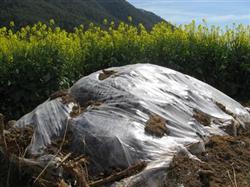
Livestock manure and urine removed from the pen are piled layer by layer at the manure collection site, compacting as you pile. If too dry, add an appropriate amount of water to keep it moist. The height of the manure pile should be 1.5 m to 2 m. After piling is complete, seal the manure pile with soil, and generally maintain the temperature at 15°C to 35°C. With this method, more humus accumulates and less nitrogen is lost. After about 3 to 4 months, the organic fertilizer can reach a semi-composted state, and it takes more than 6 months to become fully composted.
Method three: Use the alternating loose and tight pile composting method
Using alternating loose and tight piling can both shorten the composting time of organic fertilizer and reduce nitrogen loss. Pile fresh organic fertilizer loosely outside the pen to a height of about 1 m, without compacting, to allow fermentation. Generally after 2 to 3 days, the temperature inside the manure pile can reach 60°C to 70°C. After that, fresh organic fertilizer can continue to be piled, layer by layer, until the height reaches 2 m to 2.5 m. Seal the manure pile with soil, maintain the temperature, block air from entering, and prevent nutrient loss and excessive water evaporation. Generally, after 1.5 to 2 months, it can reach a semi-composted state, and after 4 months it can become fully composted.
4. Rapid microbial composting method
Spread out the organic materials to be composted (mainly a mixture of animal waste and plant straw and other waste; the mixture's moisture content is best at about 50%--60%), then sprinkle in the composting agent. Apply it at a ratio of 10 kg of composting agent (or 1 bag of Mumei Tuli compound microbial fertilizer can also be used) to 4 cubic meters of organic materials. Where conditions permit, it is best to simply turn the pile to ensure the composting agent can be evenly mixed into the organic materials.
After completing the above steps, pile it up, with a pile height of about 0.5--1 m. After piling is complete, insert a thermometer at a 45-degree angle to the ground. Observe once in the morning and once in the evening each day. If the temperature exceeds 60°C and lasts for 2 days, turn the pile. After the organic materials have no foul odor and the pile temperature drops below 40°C, a large pile can be made and set aside for use (generally about 30 days in total).
The principle of microbial composting:
Because the microbial community can effectively decompose harmful organic matter and various residues in the soil, eliminate various root metabolites and residues in the soil that affect crop growth, thoroughly purify the soil, and eliminate soil diseases and toxicity that cause continuous cropping obstacles; through high-temperature fermentation, the microbial community kills most pathogens and insect eggs at high temperature. The heat-resistant actinomycetes in the microbial community rapidly multiply and secrete large amounts of chitinase, decomposing the shells of insects and insect eggs made of chitin, thereby achieving the purpose of killing insects and insect eggs including root-knot nematodes, and fundamentally controlling root-knot nematodes.
The microbial community can convert uncomposted farmyard manure into highly efficient humified organic matter, doubling soil fertility and forming soil aggregate structure in a short time, thereby effectively improving the soil's water-holding and fertilizer-holding capacity, achieving the effects of enhancing fertilizer efficiency and significantly increasing yield.
What is organic fertilizer
What is humic acid
Click to get more organic fertilizer application techniques
Click to get more chemical fertilizer application techniques