Key technical points for stocking fish fingerlings in winter: low water temperature, low fish activity, high survival rate
Stocking fish fingerlings in winter not only improves the survival rate, but also promotes early spawning in early spring, enabling fish to gain weight quickly and bring profits early, increasing income by 40%-50%. The main techniques are:
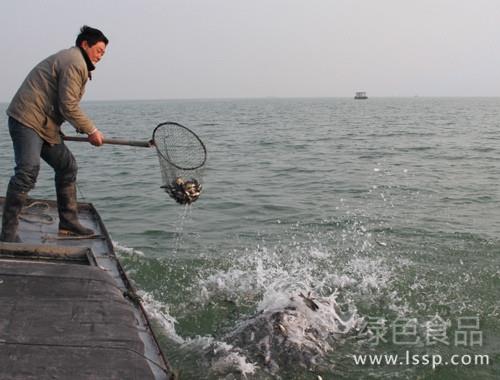
Winter stocking of fish fingerlings
I. Pond "five improvements."That is, small to large, shallow to deep, dead (water) to living (water), leaking (water) to retaining (water), risk-fighting to flood-prevention. If conditions permit, build high-yield fish ponds to ensure good fish-farming facilities.
II. Pond clearing and disinfection.It should be done on a sunny day. Pond clearing methods: First, the dry method (keeping water depth at 10 cm), that is, applying 80-100 kg of quicklime per mu, or applying 4-5 kg of bleaching powder containing 30% effective chlorine. Second, the water-retaining method (keeping water depth at 1 m), that is, using 150 kg of quicklime per mu or 12 kg of bleaching powder containing 30% effective chlorine, dissolving it in water and splashing it over the whole pond. Fish fingerlings can only be stocked 7 days after pond clearing and disinfection.
III. Fertilizing the water before stocking.After pond clearing, apply base fertilizer immediately, with 250-500 kg of human and livestock manure per mu (new ponds can apply more, fertile ponds apply less or none). After fertilizing, fill with winter water to cultivate natural feed.
IV. Stock appropriately early.The period from the Winter Solstice to around the Spring Festival is the best season for stocking; as the saying goes, "stock in the twelfth lunar month, and fingerlings grow rapidly." At this time the water quality is stable, the fish are sturdy, the scales are tight, and their activity is low, so the fish are not easily injured during handling. At the same time, it helps prevent disease and promotes early growth of the fish.
V. Carefully select fingerlings.Choose larger-sized fingerlings; generally, the body length of black carp, grass carp, silver carp, bighead carp, bream, and blunt snout bream fingerlings should reach 15-20 cm. They should have high backs and thick flesh, plump tails, complete scales, undamaged fins, bright body color, no disease or injury, and strong jumping ability.
VI. Strict disinfection.On a sunny day before stocking, the fingerlings should undergo net-pulling exercise and disinfection, and can be soaked in 3% salt water for 15 minutes. If conditions permit, each black carp fingerling over 18 cm can be injected with 0.5 ml of diluted inactivated vaccine against hemorrhagic disease of black carp and grass carp, and those under 18 cm can be injected with 0.3 ml each, to prevent and treat hemorrhagic disease.
VII. Reasonable stocking.For ponds with fertile water, silver carp should be the main species, with a mixed stocking ratio: silver carp 45%-60%, bighead carp 5%, grass carp 10%. Common carp 10%, crucian carp, bream, blunt snout bream, etc. each 10%-5%. For ponds with lean water and abundant green feed, grass carp should be the main species, with a mixed stocking ratio: grass carp 45%-55%, silver carp 20%, bighead carp 5%-10%, crucian carp, bream, blunt snout bream, etc. each 10%-5%, with a stocking density of about 1000 fish per mu.
VIII. Strengthen management.After the fingerlings are stocked, the water depth should reach more than 2 m to help prevent freezing. After the water temperature rises above 6°C, bait should be appropriately fed to promote early growth of the fingerlings.