Thick ice on fish ponds can suffocate fish to death; six measures can be taken to prevent freeze damage
Cold protection for fish ponds
Deep water prevents cold damage:Choose a fish pond that is sheltered from the wind and faces the sun, with a water depth of more than 2 m, so the fish can overwinter safely. At the same time, the water in the overwintering pond must not remain static for a long time; usually replace part of the water every 20 to 30 days, each time replacing 1/4 to 1/5 of the total pond water, to prevent pond water pollution.
Wall holes prevent cold damage:Set up windbreak walls and cold-shelter holes to prevent cold. Specific methods: on the north side of the fish pond, build a windbreak barrier more than 2 m high with rice straw or soil, and build sloped earth walls facing south on the east and west sides to form a winnowing-basket shape, to reduce attacks by the north wind. Build drainage ditches around the fish pond to prevent accumulated water outside the pond from flowing into the pond and lowering the pond temperature. On the north windbreak wall, at 40 cm from the pond bottom, dig 1 to 2 cold-shelter holes 2 m deep and 0.8 m in diameter. The hole walls can be built with bricks or embedded with ceramic pipes. When a cold wave strikes, the fish can hide in the cold-shelter holes to escape the cold.
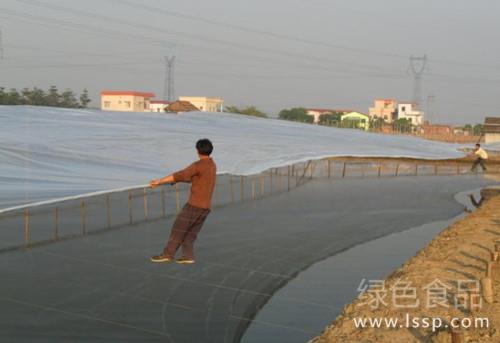
Greenhouses prevent cold damage:On the basis of setting up windbreak walls and cold-protection holes, build a plastic film cold-protection greenhouse. Use bamboo or wood to build a “person”-shaped roof along the edge of the fish pond, with the roof about 2.5 m above the ground, cover it with two layers of plastic film, and connect it with the pond edge to form a sealed cover, which can be sealed around with soil.
Heating prevents cold damage:① Steam heating: set up a stove beside the overwintering fish pond, boil water in an iron pot, and let the steam pass from a specially made bamboo tube on the pot lid through a connected rubber hose into the overwintering fish pond to raise the water temperature.
② Infrared lamp heating: in an overwintering fish pond covered with a plastic film greenhouse, install one 250-watt infrared bulb for every 35 sq m of water surface, 30 cm above the water surface, and fix a piece of thick cardboard or other water-absorbing material that easily absorbs water about 60 cm above the bulb, to prevent water vapor from condensing into water droplets on the film and falling onto the bulb, causing the bulb to burst or catch fire.
Adding feed prevents cold damage:During the overwintering period, feeding must not be neglected, especially high-protein concentrate feed. Increasing the feeding of high-protein concentrate feed can improve cold resistance and prevent the physical condition of overwintering fish from declining. When preparing it, attention should be paid to nutritional balance, especially sufficient amino acid balance, vitamins and trace elements.
Increasing oxygen prevents cold damage:If the fish pond freezes too thickly, the water body under the ice lacks oxygen, which can suffocate the fish to death. At this time, immediately sweep away snow and break the ice, replace the water in time, start aeration machinery, and regularly apply microbial preparations, etc., to improve water quality.