High mortality and culling rates in laying hens affect poultry farming profits, how can they be effectively reduced?
The problem of high mortality and culling rates in laying hens during the laying period troubles many chicken farms. In China, the mortality and culling rate of commercial laying hens during the laying period is about 10%, and for those with poor rearing conditions, it can reach more than 20%, seriously affecting poultry farming profits. High mortality and culling rates are affected by many factors, and comprehensive measures must be taken to prevent and control them.
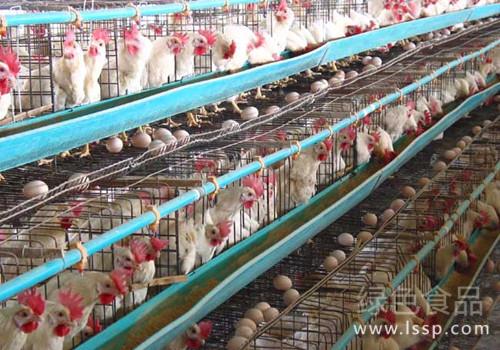
Laying hens
Strict disinfection: Rinse the chicken house with a high-pressure water gun, whitewash the walls with quicklime, disinfect the laying hen cages with a flame sterilizer, and disinfect utensils, equipment and the floor with 2%-3% caustic soda, then close the chicken house and fumigate with formalin, leaving it empty for about one month. On the day before the new chickens are put into the cages, spray-disinfect with Baidusha.
Selecting chickens for caging: Before the chickens are put into cages, they must be selected to ensure that the laying hens put into cages are healthy, uniform and well-proportioned, usually using body weight and shank length as the standard. Those that are too large or too small in body weight, or diseased, disabled and weak, must be resolutely culled, or raised in separate groups depending on the situation.
Scientific feed formulation: According to feeding standards, starting from 120 days of age, the levels of crude protein and essential amino acids in the feed for laying hens should be appropriately increased to meet the needs of the hens' body maturity and sexual maturity, so that they proceed synchronously, preventing prolapse of the cloaca and fatigue after the start of laying. At the same time, double amounts of vitamin AD3, vitamin C and vitamin E should be added to the feed to enhance the metabolic level and anti-stress ability of the laying hens.
If Sudu Bu or compound multivitamins are added to the drinking water, the effect is even better. Generally, small-scale chicken farmers had better not mix feed themselves; they can choose laying hen feed produced by reputable, large-scale feed manufacturers, which has a relatively good effect, can avoid certain nutritional and metabolic diseases, and reduce the mortality rate.
Timely calcium supplementation: From 4 months of age or when reaching a 5% laying rate, laying hens should be fed a high-calcium (3.3%-3.5%) diet. Supplementing calcium to the chickens between 12:00 and 20:00 every day helps calcium absorption. A calcium source feed in which shell accounts for 2/3 and limestone 1/3 of the diet gives the best eggshell strength. Of course, the best calcium source is high-temperature sterilized eggshell.
Adequate drinking water: Laying hens must be supplied with sufficient clean drinking water at all times, because the consequences of water shortage are often more serious than those of feed shortage. In summer, take care to provide deep well water; when the house temperature exceeds 35°C, ice cubes can be added to the water. In winter, take care to provide warm water to prevent stress on the chickens caused by excessively low water temperature.
Reduce stress: Before the new chickens are put into cages, double amounts of multivitamins should be added, and antibiotics should be used appropriately, to reduce the adverse effects of transfer stress on the laying hens. Close the doors and windows of the chicken house to prevent small animals from entering the chicken house; seal the exhaust vents with wire mesh to prevent wild birds from entering. To reduce stress, feed changes should be carried out gradually.