Meat ducks have different nutritional needs at different growth stages, so how should feeding be targeted accordingly?
During the brooding period of meat ducks, the house temperature in the first week of age should be above 30°C, then decrease day by day as the ducks age, until at 15 days of age the temperature drops to about 20°C and remains constant until slaughter.
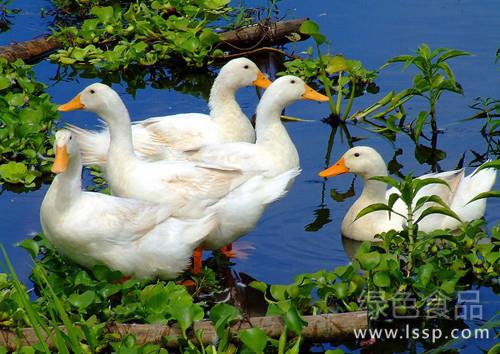
Meat ducks
A newly hatched duckling has a 5-7g yolk sac in its belly. The smaller the remaining yolk sac, the stronger the constitution; the larger it is, the weaker the constitution. If newborn meat ducks receive a suitable temperature and can drink water in time, the remaining yolk is absorbed quickly. In addition, the yolk sac can also provide early nutrition for the ducklings.
Meat ducklings must be fed little and often. But after 3 weeks of age, when they enter the fattening period, they should be given free access to feed and water.
Ducks have a poorly developed sense of taste, so attention must be paid to the hygiene of feed and litter to prevent moldy, spoiled feed and foreign matter from being mixed in. Meat ducks like pelleted feed and dislike feed that is too fine or sticky. Ducks have an innate ability to distinguish colors and like yellow feed. Ducks like to drink from blue water troughs, prefer cool water, and are unwilling to drink water warmer than their body temperature.
Meat ducks have a fast metabolism. About half of the food is excreted after passing through the digestive tract in about 4-5h, and water takes only half an hour. Because digestion is fast, the defecation rate is high, and the manure retains a large amount of organic matter and nitrogenous substances. Duck manure decomposes and produces large amounts of harmful gases such as ammonia. Therefore, duck manure must be removed frequently.
Ducks like a dry environment. A damp environment is not conducive to keeping warm in winter or dissipating heat in summer, and the belly feathers often rot and fall off because of dampness and contamination by manure water. Therefore, the litter in the duck house must be dry and hygienic.
Meat ducks eat a lot and drink a lot, and are accustomed to eating and drinking at the same time. To avoid soiling the drinking water and wasting feed, the distance between the feed pan and the water pan should be more than 1m; at the medium and large duck stage, the distance should be more than 5m. The drinking area should have good drainage and be kept away from the litter. To prevent meat ducks from playing in the water, a mesh cover should be placed over the water pan.
Meat ducks are timid and easily startled. Noise, colors, strangers and so on can make meat ducks nervous, restless and excited, causing them to scream and run around, resulting in reduced feed intake and weight loss, and in severe cases causing crushing injuries and death. Therefore, quietness around the duck house must be maintained.
Ducks are gregarious and like to live in groups, regardless of age. To ensure uniform growth and development of meat ducks, the stocking density must not be too high.
After 3 weeks of age, meat ducks grow faster, and the breast meat and leg meat develop quickly, so in the early stage a high-protein, high-energy complete feed must be provided; in the later stage the crude protein can be lower, but the energy must be increased. After 3 weeks of age, because of rapid weight gain and heavy body weight, leg development cannot keep up, and leg disease is likely to occur, so the flock should be driven up to move every 2-3h.