Spring Grass Carp Vaccination to Prevent and Control the Four Diseases, with a Detailed Explanation of the Immune Injection Method
Grass carp is highly favored by consumers for its large size, tender flesh, and few intermuscular bones. However, the "four diseases" of grass carp (red skin disease, gill rot disease, enteritis disease, and hemorrhage disease) restrict the development of grass carp farming. Long-term practice has proven that immune injection of grass carp is currently an effective way to solve the "four diseases."
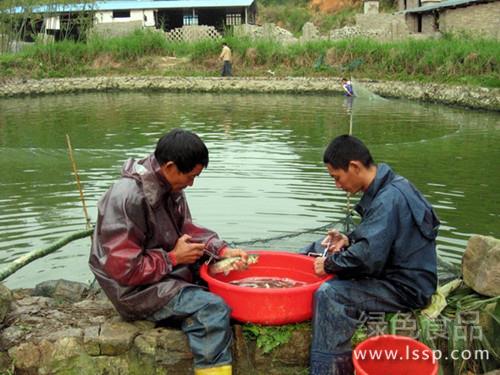
Immune Injection of Grass Carp
I. Principle:
Under low-temperature conditions (8°C-20°C), the metabolism of grass carp is relatively weak. Through injection inoculation, two-year-old grass carp can obtain a new immune antigen dose. After 5-30 days of low-temperature (10°C-15°C) induction, the injected grass carp complete their primary immune capacity. When the water temperature rises above 20°C, the immune disease resistance level of grass carp rapidly strengthens, thereby reducing the chance of disease in two-year-old grass carp.
II. Method:
1. Timing selection. Carry out in spring when the water temperature is 8°C-22°C. In northern regions, try to choose March, when the water temperature is relatively low, as this helps prevent saprolegniasis. Grass carp that have already contracted diseases are not suitable for injection immunization.
2. Fingerling preparation. Various healthy, disease-free grass carp fingerlings with a size of 8.33 cm or above can all be immunized by injection. Before injection, disinfect the fingerlings with a 0.5% saline solution for 5-10 minutes. To facilitate production operations, trichlorfon aqueous solution can be used to anesthetize the fingerlings.
3. Tool selection. Syringes, needles, and dilution vessels must be disinfected with 75% alcohol or boiling water. Fingerlings with a size below 9.99 cm generally use 4.5# or 5# injection needles, fingerlings with a size above 11.66 cm generally use 5.5# or 6# injection needles, and fingerlings with a size above 16.65 cm generally use 7# injection needles. To prevent the needle from going too deep during injection and damaging the internal organs of the fish, a small piece of plastic tubing can be placed over the needle, with the exposed needle tip slightly longer than the thickness of the fish's abdominal muscle.
4. Vaccine dilution. Before use, dilute the concentrated liquid 10 times with 0.65% physiological saline. It is best to use up a bottle of diluted vaccine in one go. If it cannot be used up, use a syringe to draw out the required amount, and after drawing, seal the needle hole with medical adhesive tape.
5. Injection site and dosage. Inject at the base of the pelvic fin of the grass carp, with the needle at a 45-degree angle to the fish body, piercing into the fish body. For fingerlings with a size below 9.99 cm, inject 0.5 mL of diluted vaccine per fish; for fingerlings with a size of 9.99-16.65 cm, inject 0.5-1 mL of diluted vaccine per fish; for fingerlings with a size above 16.65 cm, inject 1 mL of diluted vaccine per fish.