Raising chickens in orchards requires attention to supplementary feeding, disease prevention, rodent control and density management
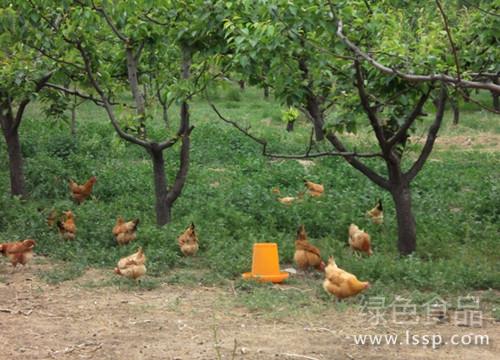
Raising chickens in orchards
1. Choose good breeds:
In orchard chicken raising, the breed is crucial. Orchard chicken raising is based mainly on free-range grazing with housing as a supplement, so local chicken breeds should be chosen that are highly adaptable, highly disease-resistant, tolerant of coarse feed and diligent in foraging. At the same time, appropriate breeds should be selected according to market demand; generally small breeds should be chosen, such as Guangdong Sanhuang chickens and Guangxi Mahuang chickens; if supplying the Spring Festival market, large breeds such as Xingza 882 should be chosen.
2. Adjust the temperature well:
After chicks are taken off heat, they are moved directly into the orchard for raising, where the ambient temperature is unstable, so during brooding the temperature must be adjusted well to adapt to the orchard environment. The body temperature of newly hatched chicks is 1—3°C lower than that of adult chickens, and their ability to resist cold and retain heat is poor, so brooding must be carried out in a brooder room, with the temperature reasonably adjusted according to the season, the number raised, the brooder room, the rearing density and the heating method. Keep it at 33—35°C in the first week, 31—33°C in the second week, and 28—31°C in the third week, then gradually transition to natural temperature and raise for one more week before moving them into the orchard.
3. Set up rain shelters:
According to the size of the flock and the area of the orchard, appropriately build some felt-roof sheds for the chicks to shelter from rain and rest. The sheds only need to be of a quality that can keep off rain, keep off heat, allow supplementary feeding and provide rest; this is essential equipment and is very important for preventing the chickens from being drenched by rain, exposed to the scorching sun, or startled by the unexpected, and is indispensable.
4. Pay attention to the weather:
In winter watch out for strong cold air, and in summer watch out for sudden changes in wind and clouds; guard carefully against strong wind and heavy rain, especially in the first one or two weeks of free-range raising. Always follow the weather forecast and constantly observe changes in the sky, and promptly switch to confinement or grazing according to the weather. Of course, after three weeks of age the chickens have stronger resilience, so management can be appropriately more extensive.
5. Do a good job of disease prevention:
In orchard chicken raising, disease prevention and elimination are key. The chickens' range of activity is wide, making disease prevention difficult. Therefore, vaccination must be carried out strictly in accordance with the epidemic prevention program designed and formulated by the animal husbandry and veterinary department according to the local disease prevalence characteristics. Strictly control the timing and dosage of vaccination. In particular, never relax at all regarding infectious diseases such as Marek's disease, Newcastle disease, bursal disease and kidney-type infectious bronchitis. At the same time, do a good job of regular disinfection, disinfection of idle periods, and disinfection on entry; if sick chickens are found, isolate and raise them separately to avoid cross-infection.
6. Control the density:
In the 1st week after leaving the heated house, about 15OO-2000 birds are stocked per mu of orchard; in the 2nd week, about 1000-1500 birds per mu of orchard; from the 3rd week on, the density can be appropriately reduced further. Limit the flock's range of activity; wire netting and other fencing can be used to divide areas for rotational grazing, grazing one week in one plot then moving to another. The orchard stocking cycle is about 1 month; in this way chicken manure feeds the orchard's small grasses, earthworms, insects and so on, giving them a period to live and multiply, and when the next batch of chicks arrives there will again be more small grasses, earthworms and so on for the chickens to eat, and so on repeatedly, forming an ecological food chain and achieving a double harvest of chickens and fruit.
Group supplementary feeding
7. Do a good job of supplementary feeding:
Before grazing each morning, feed the flock an appropriate amount of mixed feed, and after recalling the flock in the evening, feed them supplementary feed once more. The amount of supplementary feed should vary with the season; for example, in autumn and winter when orchard weeds and insects are scarce, the amount of supplementary feed can be appropriately increased, while in spring and summer it can be appropriately reduced.
8. Beware of poisoning:
Since chickens are sensitive to pesticides, attention must be paid to the chickens' safety when controlling pests and diseases in the orchard. Pest and disease control must be cleverly arranged and interspersed with idle periods. First, choose low-toxicity pesticides; second, divide the orchard into areas and use pesticides and rotational grazing by plot; third, graze only within the safe period, that is, graze again only after the pesticide's toxicity has passed, strictly preventing chicken poisoning.
9. Strictly guard against rodent damage:
There are many rodents and insects in orchards; an appropriate number of cats can be raised and manual rodent extermination carried out regularly to eliminate rodent damage, reduce unnecessary losses and save on raising costs.