How can loach farming in rice paddies save water and reduce pesticide use to cut pollution?
Farming loach in rice paddies has many advantages: first, one water source serves two uses and one field yields two harvests, giving high economic returns; second, the ecological benefits are outstanding, mainly because loach can directly eat some harmful insects, partially serving as biological pest control, saving pesticides and reducing grain pollution.
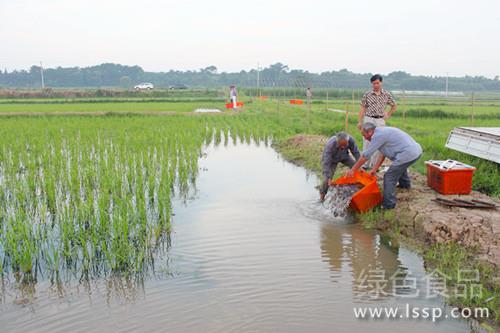
Loach farming in rice paddies
Loach likes to live on the surface of the muddy layer of decayed, cracked soil at the bottom. Besides breathing with its gills, it can also breathe through its skin and intestines. Loach is an omnivorous fish that prefers to feed at night, eating insects, small crustaceans, tender leaves of aquatic plants, diatoms, blue-green algae, green algae, yellow-green algae, zooplankton and so on. In artificial rearing it can be fed feed such as peanut cake, rice bran, wheat bran, soybean cake, silkworm pupa powder, snails, earthworms, tubifex worms, fish meat, and the internal organs of poultry and livestock. Loach is small in size and light in weight, and it is greedy; when overfed, it easily suffers from indigestion, which affects normal breathing and can cause it to die from bloating.
Loach is a warm-water fish and appears earth-yellow in rice paddies. Its growth water temperature is 15°C~34°C, with the optimum temperature being 24°C~30°C. When the water temperature is below 35°C~6°C or above 35°C~36°C, it burrows into the mud to a depth of 10cm~30cm to enter dormancy.
Rice paddy construction: For loach farming in rice paddies, choose a rice paddy with sufficient water and good water quality, with an area of 2—10 mu, and build an 80cm-high anti-escape wall around the paddy using cement, plastic boards, film, window screening, etc. (buried 30cm into the mud). Along the field ridge, build a step 20cm wide, 15cm below the top of the ridge. Dig a ""-shaped water ditch around the field and through the center, with the ditch 50cm wide and deep. Provide one inlet pipe, one drainage pipe, and one overflow pipe each, with the pipe openings blocked by fine, dense iron wire mesh. The drainage pipe is usually sealed with cement.
Loach fry stocking: The loach fry should preferably come from a loach original stock farm or be caught from natural waters, and be required to be robust, disease-free and injury-free, at age 2, with females weighing 15—25 grams and males 12 grams or more. Apply 1000 kg of fermented pig manure per mu, let the incoming water filter into the field, keep the water depth in the ditch at 30—40cm, fertilize the water body, and keep the water transparency at about 25cm. After the rice seedlings turn green, stock 20,000—25,000 loach fry of 3—5 grams each per mu. Before stocking, soak them in a 3% salt solution for 10 minutes, then put them into the field after disinfection.
Feeding management: Fertilization. During the farming process, to ensure a continuous supply of plankton, organic fertilizer must be applied promptly, in small amounts, and evenly. Apply fertilizer once every 10—15 days, using 150 kg per mu each time. In addition, according to the water color, apply about 1.5 kg of urea or 2.5 kg of ammonium bicarbonate per mu each time to keep the water body yellow-green.
Feeding: Because the density of loach in the field is high, artificial feed should be given, such as soybean cake, silkworm pupa powder, fly maggots, earthworms, snails, clams, slaughterhouse scraps, rice bran, soybean dregs, rapeseed cake, wheat bran, etc., to supplement natural food. July—August is the peak growth season for loach, requiring silkworm pupa powder at 15%, meat-and-bone meal at 10%, and soybean cake at 25%, with feeding twice a day and a feeding rate of 10%. In September—October, plant-based feed such as wheat bran and rice bran is mainly used, generally fed once each in the morning and afternoon, with the feeding amount accounting for 2%—4% of the total loach weight. In early spring and late autumn, about 2%. Adjust flexibly according to the loach's feeding situation; generally, it is appropriate if the feed is basically eaten up within 1—2 hours after each feeding.
Water level control: The actual water level above the field surface is generally kept above 5cm. Add fresh water at the right time, generally once every half month; in summer high temperatures, the water level should be appropriately deepened.
Disease prevention and control: Loach is suitable for paddy field farming, and generally no diseases occur. To prevent red-skin disease, apply 10—15 kg of quicklime per mu monthly after slaking it into slurry and splash it over the whole pond. Rice pesticide application is generally done 3—5 days before transplanting, or 5—7 days after transplanting, applying pesticide once to the seedlings for prevention.
Daily management: Patrol the field twice a day, check the anti-escape facilities, especially on rainy days, and pay attention to checking for holes. Prevent invasion by natural enemies (such as water snakes and ducks), and observe the loach's activity and feeding. It is strictly forbidden for water containing highly toxic pesticides such as methamidophos, toxaphene, carbofuran, and sodium pentachlorophenate to flow into the rice paddy.
Harvesting methods: First, water-flushing harvesting: near the water outlet, spread netting, release water from the inlet, and because loach has the habit of swimming against the water, after a certain time, lift the netting to catch them. This method is suitable when the water temperature is about 20°C and the loach is active. Second, bait trapping: put roasted fragrant bran or wheat bran into bamboo cages, place the cages in the ditch, and lure the loach into the cages. Third, dry-field catching: slowly drain the field water so that the loach gathers in the exposed ditch soil, and then catch them.