Several methods of raising fish in rice paddies, helping achieve a bumper harvest of both fish and rice and increasing economic returns
Raising fish in rice paddies to harvest both fish and rice is one of China's traditional agricultural production methods. It can not only increase production but also increase income, and is one of the paths to prosperity in rural areas. Below are several methods of raising fish in rice paddies, which can be selected according to local conditions.
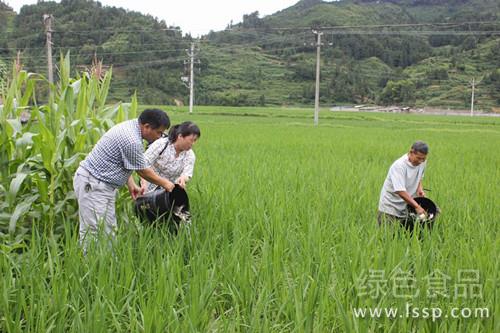
Raising fish in rice paddies
1. Flat-field type. Raise and reinforce the field ridges so that the ridges are 50-70cm high and about 50cm wide at the top. Dig fish ditches or fish pits in the rice paddy. The fish ditches are 30-50cm deep and 30-50cm wide at the top. The ditches are arranged as follows: dig 1 ring ditch at half the base of the field ridge in the rice paddy. For rice paddies larger than one mu, a cross-shaped central ditch must also be dug in the middle of the field. The central ditch connects with the ring ditch, and the two opposite ends of the ring ditch connect with the inlet and outlet. The total excavated area of the ditches accounts for 5%-8% of the rice paddy area. When rice and fish are grown together to raise market-size fish, the designed fish yield is about 30 kg per mu. If after the first season of growing rice and raising fish, only fish are raised in the second season without growing rice, then the designed fish yield per mu can reach 80-100 kg.
2. Ridge-rice ditch-fish type. This is relatively scientific. Dig a ring of main ditches around the rice paddy, with a ditch width of 50-100cm and a depth of 70-80cm. Rice is planted on the ridges, generally about 6 rows of rice per ridge, and ridge ditches are dug between the ridges, with a width smaller than the main ditches. If the rice paddy area is large, another main ditch can be dug in the center of the rice paddy. The total ditch area accounts for about 10% of the field area, and the designed fish yield is 80-100 kg per mu.
3. Fish pond type. Dig a "fish pond" in the rice paddy according to a certain proportion of the field area. The excavated area of the fish pond is about 5%-8% of the field area, with a depth of 2-2.5 m. The fish pond is set in the center of the field or in a shady place, and must never be set at the inlet, outlet, or a dead corner of the field. The shape of the fish pond is best as an elliptical pot bottom or a rectangle. The fish pond is dug in a two-stage slope form, that is, the upper 1 m is excavated at a slope ratio of 1:0.5, while the lower part is excavated at 1:1, with a 30cm-wide platform left between the two parts. Where conditions permit, to ensure it does not collapse, stone strips, stone slabs, cement slabs, crushed stone, etc. should be used to protect the slope. To prevent silt from entering the fish pond, a small ridge 20cm high and 30cm wide should be built at the edge of the pond mouth. A ring ditch 40cm deep and 30cm wide should be dug in a ring around the field at a distance of 3-3.5 m from the field base. The designed fish yield per mu is 50-70 kg.
4. Ditch-pond type. A small pond and fish ditches are set up at the same time, and the total excavated area accounts for 10%-15% of the field area. The small pond is set at one end of the rice paddy inlet, with an excavated area accounting for 4%-8% of the field surface. It is rectangular, 1-1.5 m deep, and a shade shed is set above it. At the boundary between the pond and the field, a small ridge 20cm high and 30cm wide is built. In the field, ring ditches and central ditches can be set according to the size of the rice paddy area, with ditch width of 30-40cm and depth of 28-30cm. The central ditch is in a cross shape or a well shape, so that the ditches and the pond are connected.
5. Flowing-water pit-ditch type. This is designed according to the principle of flowing-water fish culture. In this method, at one end of the rice paddy inlet, 1 m from the inlet, a flowing-water pit (also called a wide ditch) is dug with a depth of 1-1.5 m and an area accounting for 4%-8% of the rice paddy area. At the junction with the field surface, a field ridge 15cm high and 20cm wide is set, and 2-4 gaps are set between the ridge and the field so that the water in the pit and the water in the field are connected. In addition, the fish pit can also be set in the center of the field. A cross-shaped central ditch is set in the center of the field, and a ring ditch is set around the field. The width and depth of the ditches are both 25cm. The ditches and the pit must be connected. The designed fish yield is more than 50 kg per mu, but not more than 80 kg.