Management points for broiler feeding: improper feeding causes feed waste
The production level of broilers depends on the genetic potential of the chickens, and besides being closely related to the living environment, this internal potential is also greatly related to feeding management. At present, many chicken farmers do not pay much attention to feeding management, which affects broiler growth and development, causes feed waste, and reduces rearing results. Chicken farmers should carry out good feeding management from the following aspects to improve broiler rearing results.
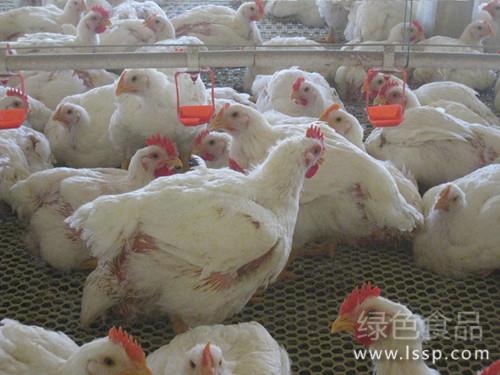
Broilers
(1) Grasp the timing of first feeding: after the chicks arrive at the chicken house, let them drink water first for 2-3 hours, then start feeding when 1/3 of the chicks show pecking behavior or at 24-36 hours after hatching. Both too early and too late are unfavorable to the chicks. If first feeding is too early, it affects the absorption and utilization of yolk in the chicks' bodies and causes indigestion, thereby affecting chick development and feed utilization. In addition, if first feeding is too early, chick activity and chicken manure will contaminate the feed, affecting flock health. If first feeding is too late, the yolk in the chicks' bodies is consumed excessively, the body is weak, and this likewise affects chick development and survival rate.
(2) Provide sufficient feeding space: after 7 days of age, each chicken should have a feeding space at least 5 cm wide. As age increases, the feeding space should be increased, reaching about 10 cm at 49 days of age. If feeding space is insufficient, it will affect the feed intake of some broilers and easily cause uneven flock size.
(3) Regularly adjust feeder height: as broiler age increases, feeder height should be adjusted regularly. The upper edge of the feeder should be level with the chicken's back or 2 cm higher. Chickens have no teeth and have a soft palate, so when pecking feed and drinking water, they must raise their heads to enter. If the trough is set properly, it can reduce feed spilling from the beak and reduce feed waste.
(4) Adjust feeding frequency: at 1-3 days of age, feed once every 2 hours, with a 4-5 hour pause at night; after 3 days of age, gradually reduce feeding frequency to 6-8 times per day and night; in the later stage, 4-6 times. The digestive tract of chicks is not fully developed, they have no teeth, the crop is relatively small, the ability to secrete digestive enzymes is incomplete, and digestive capacity is poor, so at the beginning stage they should be fed less and more frequently. As age increases, feeding frequency should gradually decrease.
(5) Control the amount fed each time: the amount added each time should not be too much, because chickens have poor digestive capacity and eating too much can easily cause indigestion and affect feed utilization. The daily feed amount should be reasonably calculated and evenly divided according to feeding frequency. Wait until the previous feed addition has been eaten before adding more, or wait a short while before adding more. Feed should not be added on top of feed, otherwise it easily causes indigestion and selective eating in chickens, affects chicken growth and health, and also easily causes feed contamination.
(6) Provide high-quality feed: broilers grow and develop quickly, and their digestive function is not yet complete, so a complete compound feed that is easy to digest and nutritionally balanced should be supplied. Broiler rearing is generally divided into three stages: 0-20 days of age is the brooding period, 21-38 days of age is the middle period, and 39 days of age to market is the later period. Different feeds should be supplied according to the stage.
(7) Feed changes need a certain transition period: during the rearing process, because the nutrients required at different stages differ and raw materials also change, feed changes are unavoidable. If the feed change is improper, it will cause stress to broilers. Suddenly changing feed may cause digestive function disorder in chickens, causing indigestion, diarrhea, and so on, affecting broiler growth and feed utilization. Practice shows that if the feed change is carried out gradually, it has basically no effect on broiler production. When changing feed, a transition of generally 5-7 days is needed. The specific method: 2/3 of the previous feed (the feed currently in use) and 1/3 of the next feed (the feed to be changed to), for 2 days; 1/2 of the previous feed and 1/2 of the next feed, for 2 days; 1/3 of the previous feed and 2/3 of the next feed, for 2 days, then completely change to the next feed.