Key points for raising crayfish: feed feeding, escape prevention and harvesting
Raising crayfish
Pond requirements: sufficient water source, good water quality, convenient water inlet and drainage, generally 3—5 mu. The pond bank should have a certain slope, and to prevent crayfish from escaping, the pond bank should be more than 1.5m wide, and a 0.5m-high escape wall or escape board with a smooth inner wall should be set around the pond bank. Build multiple mud banks in the middle of the pond to create burrowing habitats for crayfish. However, the two ends of the mud banks should not be connected to the pond bank; the length of the mud banks should be about 4/5 of the pond length, the bank width should be more than 1 meter, and the bank should be 5-10cm above the water surface. The pond water depth should preferably be 0.8-1.5m; it is best to have deeper water in the middle and shallow shoals around the edges, with tree roots, bamboo tubes, etc. placed at the bottom of the pond. Before stocking, strictly disinfect, and apply 300-500 kg of decomposed livestock and poultry manure per mu. Aquatic plants should be planted in an area accounting for 30% of the pond area, such as tape grass, hornwort, water hyacinth, water lettuce, alligator weed, etc., to provide habitat for crayfish during molting and to avoid attacks by enemies.
Juvenile crayfish stocking: mainly three models are adopted. First, summer stocking: in mid-to-late July, stock the first batch of juvenile crayfish hatched that year, with 30,000-40,000 juveniles above 0.8cm per mu. Second, autumn stocking: from mid-August to September, stock large-sized fry or seed crayfish cultivated that year. For fry about 1.2cm, stock 25,000-30,000 per mu. For seed crayfish 2.5-3cm, stock 15,000-20,000 per mu. Third, winter-spring stocking: in December or March-April of the following year, stock crayfish that do not meet the market size for that year, with 15,000-20,000 seed crayfish of 100-200 crayfish/kg per mu, and after winter-spring culture, harvest from June to July.
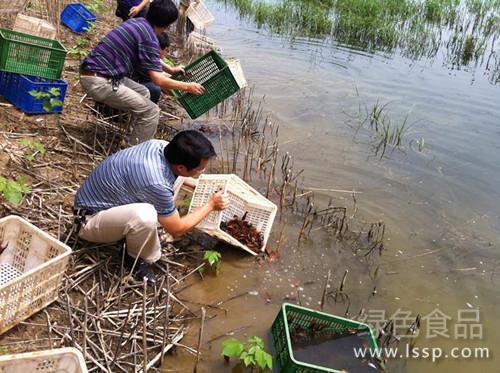
Juvenile crayfish should be robust, with complete appendages, no injuries or diseases, and strong activity, and the stocking size in the same pond should be consistent, stocked all at once. Before stocking, first put the juveniles into a plastic basin, slowly add a small amount of pond water to the basin until the water temperature in the basin is close to the pond water temperature, then add 3%-4% salt water according to the water volume in the basin, soak and disinfect for 5 minutes, then slowly release the juveniles into the pond along the pond edge. When stocking, avoid exposure to direct sunlight. If the fry are purchased from other places and have been out of water for a long time so that some crayfish are unconscious, place the juveniles in a water basin for 20 minutes before releasing.
Feed feeding: you can directly feed minced miscellaneous fish, snail and mussel meat, silkworm pupae, earthworms, slaughterhouse offal, rice bran, soybean cake, wheat bran, pumpkin, sweet potato, fresh tender aquatic plants, etc., or feed formulated feed for crayfish, but the crude protein content of the feed should be kept above 25%.
From July to October, the water temperature is suitable, and this is the peak growth season for crayfish. The daily feeding amount should be based on the crayfish eating their fill, finishing the feed, and leaving no residual bait. Generally, animal feed accounts for 8%-12% of crayfish body weight, and dry feed or formulated feed accounts for 3%-5% of crayfish body weight. Feed should be placed in shallow water at the pond edge, fed twice a day, once in the morning and once in the evening, with the evening feeding amount accounting for 60%-70%. In other seasons, feed once a day around sunset, with a daily feeding amount of 2%-5% of crayfish body weight. Crayfish have poor swimming ability, a small range of activity, and a habit of occupying territory, so feeding must adhere to fixed time, fixed location, fixed quality, and fixed quantity. In addition, feed feeding should be increased on sunny days, reduced during high-temperature muggy weather, continuous rainy days, or when the water quality is too dense; feed less when a large number of crayfish are molting, and more after molting.
Daily management: insist on patrolling the pond every day and deal with problems promptly. Apply fertilizer at the right time; one week after stocking the fry, apply 50-60 kg of decomposed livestock and poultry manure per mu, and in the middle and late stages of culture, apply 15-20 kg of fermented manure per mu every half month, keeping the pond water bean-green or tea-brown, with transparency of about 35 cm. Frequently add and change new water; in high-temperature seasons, change water once every 5-7 days, and at ordinary times once every 15-20 days, with each water change amounting to 20%-30% of the pond water, keeping the pond water pH between 7-9 and dissolved oxygen greater than 4 mg/L. Regularly disinfect and improve the water body; every 15 days, apply 10-15 kg of quicklime per mu dissolved in water and splash it over the whole pond once, and every month apply 0.5-0.6 g of bleaching powder or Disinfectant King per cubic meter of water dissolved in water and splash it over the whole pond, and in the middle and late stages of culture, apply 5-6 g of photosynthetic bacteria and 40-60 g of substrate improver per cubic meter of water dissolved in water and splash it over the whole pond each month, to maintain a good water environment.
Harvesting for market: crayfish grow relatively fast. After 3-5 months of rearing, when the adult crayfish reach more than 30 g, they can be harvested for market. There are many harvesting methods, including shrimp cages, cast nets, drag nets, or draining the pond to catch them. Harvesting should adopt the method of catching large ones and leaving small ones; those that do not reach market size should continue to be kept in the pond for rearing. It should be noted that before harvesting, drugs should be used cautiously for disease prevention and treatment, otherwise it will affect the recapture rate of crayfish, the quality of commercial crayfish, and the economic benefits of culture.