Key techniques for achieving high-yield lotus root and fish co-culture in lotus fields
Lotus-fish co-culture refers to a technique of growing lotus roots and raising fish in the same water body, with fish and lotus living together for either a long or short period, achieving high yields of both fish and lotus. A large number of aquatic weeds, aquatic insects, and benthic organisms in lotus fields compete with lotus roots for water, nutrients, and light, affecting lotus growth, but they can serve as fish feed. Raising fish in lotus fields not only clears weeds from the lotus field and controls pests and diseases, but the fish also reduce soil bulk density, increase soil porosity, and improve soil fertility.
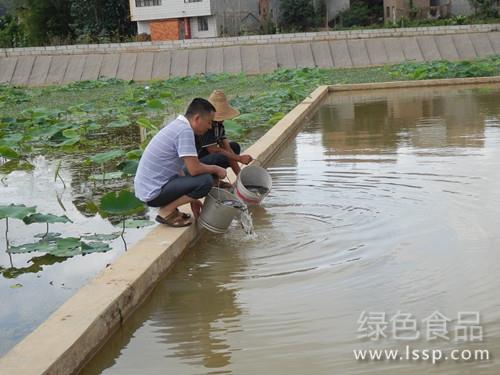
Raising fish in lotus root fields
I. Symbiosis engineering design. A ""-shaped (concentric rectangle) design is adopted, meaning ditches are dug around the perimeter of the lotus root field, with a ditch width of 2.5 m, a ditch depth of 1.5 m, and an outer embankment height of 1.5 m, with a reserved path about 3 m wide for field access. The perimeter ditch area accounts for about 10% of the total lotus field area. The advantage of this design is that the water level in the ditch will not change greatly due to fluctuations in the lotus field water level, which can satisfy the water environment needed for fish growth and ensure fish growth. In addition, because ditches are dug around the perimeter and the embankments are relatively high, losses to lotus roots during storms can be reduced.
II. Variety selection:
1. Fish species selection. When stocking fry in lotus root fields, 35-45 kg per mu is appropriate. Generally, the mix ratio is 60% common carp and crucian carp, 20% bream, 15% silver carp and grass carp, and 5% black carp. A small number of other fish species can also be appropriately stocked, such as Clarias gariepinus and snakehead. The stocking quantity of herbivorous fish should be strictly controlled, otherwise it is harmful to lotus root growth.
2. Lotus root variety selection. For lotus roots, mid-to-late maturing varieties should be selected, such as "Baoying Meiren Hong" and "Suzhou Manhe".
III. Stocking fry, planting lotus, feeding, and fertilizing:
1. Fry stocking. Fry should be stocked half a month after the engineering ditches are dug and disinfected, generally from early to mid-March to mid-to-late April. The fry size is generally 30-50 g per fish. For herbivorous fry, if sufficient green feed can be guaranteed, the stocking quantity can be appropriately increased; for omnivorous fry, the stocking quantity can be increased according to feed supply conditions. Crucian carp fry can be stocked at 300-500 fish per mu, and Clarias gariepinus can be stocked at 100-200 fish per mu. However, the total stocking amount should preferably not exceed 50 kg per mu.
2. Lotus root planting. The planting time for lotus roots is from March to May. The amount of seed used should be slightly less than conventional cultivation, generally about 200 kg per mu. When planting, for the lotus seed at the inner embankment connected to the surroundings of the lotus field, the terminal bud should face toward the center of the field and be more than 1 m away from the embankment.
3. Fish feeding. A large number of aquatic weeds, insects, benthic organisms, and other organisms in lotus root fields can be eaten by fish. If using an extensive farming method, feed may not be supplied. To obtain high yield, a certain amount of feed should be supplied starting from the end of March, and the amount of feed per feeding should account for 10-20% of the total fish weight.
4. Fertilizing. The base fertilizer for lotus roots should be applied early and heavily. Generally, 2500 kg of organic fertilizer and 30 kg of urea per mu are applied during land preparation. The main topdressing for lotus roots is urea, and the amount of topdressing can be reduced by about 50% compared with general cultivation conditions. To prevent fertilization from affecting fish, a method of applying on one half first and the other half afterward can be adopted, with an interval of 1-2 days, so that the fish have room to move.
IV. Water level management. One week before transplanting lotus roots, the lotus field should store water at 5 cm, and the water in the fish ditch should be separated from the lotus root field; after transplanting lotus roots, the water level in the lotus root field should be maintained at 3-6 cm until a large number of floating leaves appear in lotus root growth, then the water level should be gradually deepened to allow fish to enter the lotus root field to feed and move about. In August-September, the water level should be above 40 cm, with water changed once every 3-4 days.