Key technical points for intensive grass carp cage culture to help you achieve high yields
In recent years, the grass carp market has been improving, and grass carp farming, especially intensive methods such as cage culture, has become fairly common. How to achieve high yield and high efficiency in intensive farming is a technology urgently needed by many fish farmers. Based on practical experience, here is a discussion of grass carp cage culture technology:
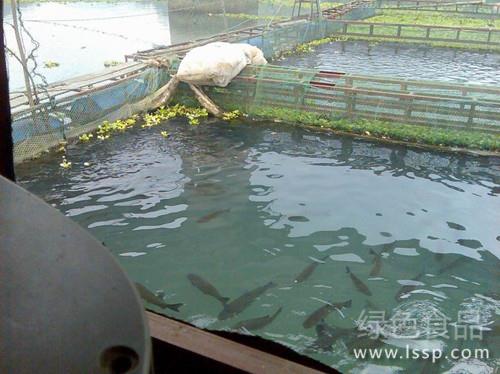
Cage culture of grass carp
Suitable farming conditions:
For cage culture of grass carp, it is advisable to choose a location that is sheltered from the wind and faces the sun, with an open water surface, stable water level, fresh water quality, pollution-free water source, and convenient transportation. The water body should be rich in dissolved oxygen, with a pH of 7.0—8.5, a water depth of 4—5m, water transparency above 50cm, dissolved oxygen of about 5 mg/L, and complete water conservancy facilities that allow drainage and irrigation and are not easily affected by floods.
Reasonable cage setup:
The cage is woven from polyethylene material and has a double-layer structure. The inner layer is a closed knotless cage, and the outer layer is an open knotted cage. The top cover net is a single layer. The inner mesh size is 3—3.5cm, and the outer mesh size is 4cm. The cage specification can be 5m×5m×2.5m. The cage frame is made from 4 lengths of moso bamboo, each 8m long. The sinkers are long stone strips tied to the 4 bottom corners of the cage so that the cage fully unfolds and takes shape in the water. The cage is fixed with cables. The cables are thick polyethylene ropes with a diameter of 4cm. The cables stretch across the water surface and, after being pulled taut, are tied to fixed stakes on the shore. The two cables are 8m apart. After the cage is fixed by the cables, the upper edge of the cage should be 20—30cm above the water surface. The cage should be put into the water 10 days after the fingerlings are stocked, so that algae can grow on the netting, making the mesh smooth. After the fingerlings enter the cage, this helps avoid the netting scratching the fish bodies, because when the fingerlings first enter the cage they are not adapted and are prone to collision and scratching. Cages can be installed singly or in groups. For single-cage installation, the spacing between cages should be more than 25m. When installed in groups, every 5—10 cages form one group in a series arrangement, either in a single row or double row. Within a group, the spacing between cages is 4m, and the spacing between groups is about 100m. The arrangement direction of the cages should be perpendicular to the direction of water flow. To prevent debris from damaging the cages, a fence should be set up outside the farming water area.
Scientific fingerling stocking:
First, the fingerlings should be superior, requiring a robust physique, uniform size, intact scales and fins, and no disease or injury. Fingerlings entering the cage must be healthy, avoid trauma, and prevent the nets from scraping off the fish body mucus. When selecting fish, those that are smooth and slimy are suitable, while rough ones are not. When catching fish, move in the direction the fish are swimming, and do not grab them head-on, so as to avoid injury. Second, the size should be large. When stocking, it is advisable to stock large-size fingerlings over 20cm, which not only have strong disease resistance and a high survival rate, but also have a short farming cycle and can be marketed by the end of the year. Third, the density should be appropriate. For cage stocking of grass carp, with a size of 300—500 grams/fish, the stocking rate is about 20—25 fish/sq m. In the cage, a suitable number of silver carp and bighead carp with a size of 200—300 grams/fish, and bream fingerlings with a size of 100 grams/fish, can also be polycultured. Fourth, pay attention to methods. Before the fingerlings enter the cage, they must be bathed and disinfected to kill external parasites and reduce the probability of pathogen transmission. Generally, they are soaked in 3%-5% salt water or 20ppm potassium permanganate solution for 15 minutes. Generally, stocking is done in late autumn or early winter. When the water temperature is about 15°C, stocking is better. At this time, after entering the cage, grass carp can still feed and have a recovery period. After spring begins, they can start feeding early, increasing the fish growth time and laying the foundation for high yield and high efficiency.
Careful feed feeding:
For cage culture of grass carp, it is not advisable to feed large amounts of grass. Instead, complete pellet feed should be fed to improve feed utilization and reduce water quality pollution from leftover bait. Grass carp can begin feeding 2—3 days after entering the cage. Before feeding, domestication training should be carried out. According to the rhythm of “slow-fast-slow” and the feeding amount of “little-more-little”, domesticate for 1—1.5 hours each day for 10 consecutive days. When most grass carp can float up to compete for food, normal feeding can begin. The daily feeding amount is 3%-5% of the total fish body weight, with 3—4 feedings per day, each feeding lasting about 0.5—1 hour, until most fish are full and swim away. Each feeding amount should also be reasonably adjusted according to water temperature, weather, fish feeding and activity conditions, and so on. In terms of feeding methods, pay attention to the “four fixed” principles. For feeding, scatter the feed in small handfuls. After one handful is finished, scatter the second handful. When the fish are not competing fiercely for food, feed slowly in small amounts so that weaker fish can also eat the feed and ensure balanced growth. Grass carp grow fastest when the water temperature is 25°C-34°C, so the feeding amount should be increased. In bad weather such as rainy, muggy, or thunderstorm weather, feeding should be reduced or stopped. Green feed can be fed once every evening. After disinfection with 1% bleaching powder, put it into the cage. The feeding amount should be based on there being no leftover grass the next day.
Daily management must be strengthened:
For cage culture of grass carp, daily management is crucial. Mainly do the following aspects well: (1) Persist in cage inspection. Inspect the cage every day, regularly check fish growth, reasonably adjust feeding, carefully observe and analyze fish conditions, promptly handle problems found, and keep a cage culture log, recording daily water temperature, feeding, feed amount, dead fish, and disease conditions. (2) Frequently brush the cage. Wash and brush the cage once every 10 days to 15 days or so, remove leftover bait, dirt, and attached algae, and allow full water exchange. (3) Regularly check the cage. Often inspect the cage and repair damage promptly to avoid fish escape or entry of fierce fish into the cage. During the flood season, also promptly check rope strength, whether the cables are firm, and whether the netting has become deformed, and so on. (4) Often adjust the cage. As reservoir water levels rise and fall, the cage must be adjusted to a position with suitable water depth and water quality.
Fish disease prevention and control must be taken seriously:
First, persist in healthy farming, operate according to regulations, and prevent disease before it occurs. Second, do preventive work well and carry out artificial immunization. Generally, before entering the cage, inject inactivated tissue slurry vaccine for the grass carp “three major bacterial diseases” and inactivated tissue slurry vaccine for grass carp hemorrhagic disease, with doses ranging from 0.2 mL to 0.5 mL. Fingerlings over 8 cm can be injected, mainly at the base of the dorsal fin and the base of the pelvic fin. At the same time, before the fingerlings enter the cage, they must be soaked in salt water for body disinfection. Regular disinfection for disease prevention is also needed. About every 10 days, feed medicated bait once for 3 days to 5 days continuously to prevent parasites in the fish body. Every 10 days to 15 days, use 150 grams to 200 grams of quicklime per cage, slake it into slurry, and splash it over the whole cage while hot to purify water quality. Every month, use insecticidal drugs and bactericidal drugs and splash them over the whole cage. In high-temperature seasons, the hanging bag method can be used around the cage, and drugs such as bromochlorohydantoin, copper sulfate and ferrous sulfate mixture, and so on can be selected. In addition, note that green feed must be disinfected before feeding. Persist in feeding high-quality feed, and do not feed spoiled or expired feed. Cage-cultured grass carp are generally susceptible to saprolegniasis, red skin disease, bacterial gill rot, enteritis, hemorrhagic disease, and so on. When disease occurs, it is advisable to ask professional technicians to diagnose correctly and prescribe the right medicine. Do not fail to treat disease or treat it indiscriminately, causing losses artificially.