There are principles for formulating meat goose diets; you cannot just feed whatever is available.
In recent years, the meat goose market has looked promising and breeding returns are high, but when feeding meat geese, some farmers are very casual and "feed whatever they have," resulting in poor returns. To formulate meat goose diets, the following principles should be followed:
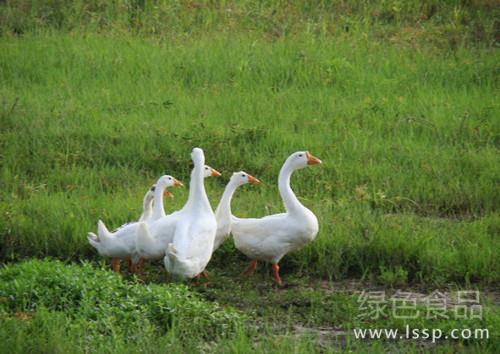
Meat goose
1. Complete nutrition:Meat goose diets must be nutritionally comprehensive and meet the growth and development needs of meat geese at every age stage. Under normal circumstances, for young geese before 4 weeks of age, the protein content should reach 20%; for older geese after 4 weeks of age, the protein content is 18%. The calcium-to-phosphorus ratio in the diet should be reasonable: for young geese, the calcium-to-phosphorus ratio is 2:1, the calcium content in the feed is 1%, and the phosphorus content is 0.45%; for older geese, the calcium-to-phosphorus ratio is 3:1, the calcium content is 2%, and the phosphorus content is 0.7%. The salt content in the diet should be properly controlled: 0.3%-0.44% for young geese and 0.4%-0.5% for older geese. During the growing period before 10 weeks of age, each kilogram of feed should contain 11.3 megajoules of metabolizable energy; during the fattening period after 10 weeks of age, energy increases and protein decreases, with each kilogram of feed containing 11.7 megajoules of metabolizable energy and protein reduced to 12%.
2. Targeted formulation:When formulating meat goose diets, local feed should be fully utilized and external purchases minimized as much as possible. In this way, while ensuring nutrition, breeding costs can be reduced as much as possible and maximum returns obtained. Where grazing conditions are available, the older goose stage should be based mainly on grazing with supplementary feeding as a secondary measure; at this time, increase the feed energy appropriately to 0.84 megajoules/kg, while reducing protein to 1%-2%, and the salt content should reach 0.5%. During the feather growth period, meat geese have an increased demand for sulfur-containing amino acids, so the use of additives such as methionine, cystine, and cysteine can be increased in a targeted way, or 3%-5% feather meal can be added to the feed. Different meat goose breeds have certain differences in nutritional requirements, so breed characteristics must be fully considered when formulating diets.
3. Reasonableness:When formulating meat goose diets, the feeding and digestive characteristics of meat geese must be fully considered. In meat goose feed, protein feed generally accounts for 40%-60%, bran and middlings account for 15%-20%, oilseed cakes and meals account for 10%-15%, animal-based feed accounts for 3%-5%, and mineral feed accounts for 2%-3%. Legume hay meal is rich in protein; appropriately increasing it can reduce the amount of protein feed used and lower feeding costs, with usage up to 15%-30%. For feeds such as feather meal and blood meal, although the protein content is high, the digestibility by meat geese is low, so the added amount should be below 5%. Geese are herbivorous waterfowl. If there are no grazing conditions, a suitable amount of high-quality forage grass should be planted, harvested, and added to the meat goose diet, or 3%-5% hay meal can be added to the feed. Meat geese are prone to being picky eaters. If conditions permit, powdered feed can be processed into pellets; this not only prevents waste caused by picky eating, but also makes feeding and intake more convenient and reduces feed contamination during meat goose feeding.
4. Stability:Meat goose diets should be continuously adjusted as the geese grow older, but adjustments to the feed formula should have a transition period of about 1 week. Within a certain growth stage, the stability of the diet formula should be maintained to prevent stress caused by frequent or sudden dietary changes. The composition of the diet should also have a certain stability. Whether to use corn, sorghum, wheat, or paddy rice for energy feed; whether to use cottonseed cake, rapeseed cake, soybean cake, or peanut cake for protein feed; and whether to use fish meal, silkworm pupa meal, blood meal, or meat-and-bone meal for animal-based feed must all be considered comprehensively and handled flexibly according to local production and meat goose breed characteristics. Once determined, do not change them easily. The goose gizzard and ceca are well developed, and older geese can digest 40%-50% of the crude fiber in feed. The cellulose content in young goose feed should account for 5%-7%. Maintaining the stability of crude fiber in the feed can both meet the physiological needs of meat geese and reduce feed costs.
5. Safety:The raw materials selected for formulating meat goose diets should be reliable, free from insect damage and mold, free from pesticide contamination, and free from other toxic and harmful substances. Meat geese can consume many kinds of green feed, but its use must be hygienic: green feed should be washed clean, and aquatic feed should be dried until semi-dry and must not be fed casually. If grit needs to be supplemented, choose river sand from uncontaminated river sections, wash it clean with clear water, dry it in the sun, and feed it separately in a container; each feeding amount should be appropriate to prevent contamination from being left too long. Farmers have limited storage conditions, so in summer and autumn only enough diet for 3-5 days should be mixed at a time; mixing too much at once makes it prone to mold and spoilage. When feeding wet mixed feed, mix it accurately according to the meat geese's feed intake, and do not leave overnight leftovers. Do not feed overnight green grass pulp, to prevent nitrite poisoning. Green feed containing more oxalic acid, such as spinach and beet leaves, must not be fed excessively to young geese, to prevent rickets.
6. Palatability:When formulating meat goose diets, the selected raw materials should have good palatability. Raw materials with hard shells or seed coats, such as paddy rice, wheat, and corn, are best crushed and processed before being mixed with other raw materials. Cereal raw materials should not be ground too finely, as too fine a grind affects intake and palatability. Tofu residue contains trypsin inhibitor, so it must be heated and boiled before use; in addition, because of its high water content, it is best dried in the sun before being mixed into the diet. To make it convenient for meat geese to eat, green feed and root and tuber succulent feed should be chopped before feeding, and green vegetables with more crude fiber should also be cut as finely as possible.