Desalination treatment of Japanese sea bass and spring stocking methods, high benefits from freshwater pond culture
Japanese sea bass, also known as sea bass, is a carnivorous fish with tender flesh and rich nutrition. The suitable temperature for culture is 3°C to 29°C, and the most suitable water temperature is 16°C to 27°C. It can overwinter naturally and is a euryhaline fish species. After the fry of Japanese sea bass undergo desalination treatment, when stocked in spring with fingerlings about 10 cm in size, after 5 months of rearing, they can reach 400 g to 500 g in body weight, with a yield of about 500 kg per mu and good benefits. The following briefly introduces the key technical points for culturing Japanese sea bass in freshwater ponds.
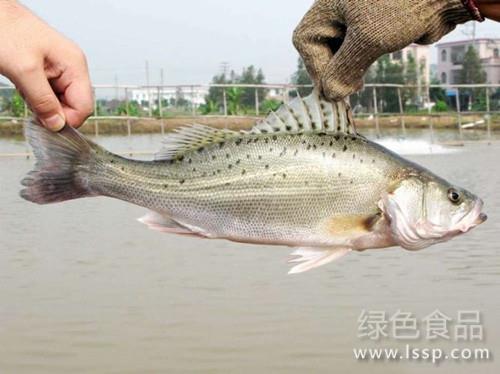
Japanese sea bass
1. Pond conditions. For adult Japanese sea bass culture, the pond area should preferably be 1 mu to 5 mu, with sandy loam soil as the bottom quality, relatively little silt, a flat pond bottom slightly sloping toward the drainage outlet, a water depth of 1.5 m, a complete drainage and irrigation system, and sufficient, fresh, pollution-free water of good quality. After the pond is dried and exposed to the sun, about 10 cm of water should be added 10 days to 15 days before stocking, and 80 kg to 100 kg of quicklime per mu should be used; the next day, add another 5 kg of bleaching powder, dissolve in water, and splash over the whole pond.
2. Feed feeding. Japanese sea bass has strong predatory behavior. It can be fed fish paste or frozen fresh small miscellaneous fish and chunks of wild miscellaneous fish meat. After domestication, it can be fed compound pellet feed. Before feeding, splash water several times first to form a conditioned reflex, then feed the pellet feed. After several times of conditioning, as long as they hear the sound of splashing water, the Japanese sea bass will swim over in groups to feed. Choose a location in the middle, use bamboo or wooden springboards extending into the pond water surface, 6 m to 7 m from the pond bank, to set up a feeding point. With such a feeding point, the feed scattering area is large, the water is not easily muddied when the fish feed, and it can accommodate more fish to feed evenly. Daily feeding amount: when the fish are relatively small in the early stage, feed at 8% to 15% of fish body weight, 3 times to 5 times a day; later, as the fish grow larger, feed at 3% to 5% of fish body weight, 2 times a day. The feeding amount should be adjusted in a timely manner according to the fish's feeding and growth conditions. According to the habit of Japanese sea bass not liking strong light, feeding is vigorous at sunrise and sunset, and it almost does not feed at noon, so it should be fed twice, in the morning and evening. When feeding, the principle of "slow, fast, slow" should be mastered: feed less at the beginning, and after attracting the fish to gather, feed quickly and promptly expand the feeding area so that the fish school can eat evenly and fully. When the fish are almost full and the competition for food is no longer intense, feed less again, and continue feeding until most of the fish leave the feeding point. Generally, each feeding takes about half an hour to prevent the feed from sinking to the bottom, causing waste and polluting the water body.
3. Fry and fingerling stocking. After desalination treatment, Japanese sea bass fry and fingerlings are cultured to a body length of about 10 cm and then put into ponds for adult fish culture, with a high survival rate. The stocking size should be as uniform as possible to avoid cannibalism. The stocking density should preferably be 1000 fish to 1500 fish per mu, and at the same time, 40 large-size bighead carp fingerlings, 20 silver carp fingerlings, and 200 Pengze crucian carp can be stocked in combination to make full use of the water body, regulate water quality, and increase yield.
4. Water quality regulation. Japanese sea bass is a benthic fish and likes to live in water that is clean, with relatively high dissolved oxygen (4 mg to 6 mg/L), and a transparency of 30 cm to 40 cm. During adult fish culture, new water should be added flexibly and promptly according to water color and transparency. In the early stage, because the fish are small and the temperature is low, water quality is easy to control, so the cycle for adding and changing water can be longer. As the fish grow and the pond biomass increases, pond patrols should be done frequently, new water should be injected often, and aerators should be used reasonably for aeration. September to October, when the temperature is suitable, is the rapid fattening stage for Japanese sea bass, and water quality regulation must not be neglected.
5. Harvesting. Japanese sea bass is very easy to catch. Japanese sea bass cultured in ponds can be caught at more than 90% of adult fish after 1 to 2 seine nettings. However, two points need attention: first, before seine netting for harvesting, feeding should be stopped for 1 day, because fish that have eaten their fill have a large stomach volume and are very likely to be injured after being bumped by other fish; second, Japanese sea bass is fierce by nature, and when seining, it is also easily bruised and mutually punctured due to fright. Therefore, when seining, try to choose a net with small mesh to catch fish, take fish according to the amount needed, and try not to seine the whole pond. When lifting the net, keep the net in the water, and take fish section by section in the net without leaving the water, so that commercial fish not yet sold or commercial fish being inspected and caught suffer less damage. Ponds that have been seined should undergo one water body disinfection mainly for preventing saprolegniasis.