Provide bait, loosen the soil, and raise yellow catfish in pollution-free lotus root fields
Lotus root ponds contain many benthic organisms, aquatic insects, plankton, pond weeds, etc., which can provide bait for fish, while fish droppings and leftover bait can provide fertilizer for lotus roots, and fish activity loosens the soil, providing good soil conditions for lotus root growth. Because lotus leaves shade and block light, the light intensity in the lotus pond environment is relatively weak, which suits the requirement of yellow catfish (Pelteobagrus fulvidraco) for feeding and growth under weak light.
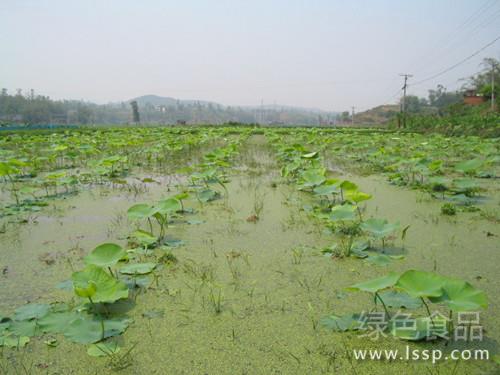
Raising yellow catfish in lotus root fields
Pond construction. Choose a pond with abundant water, good water quality, fertile soil, flat terrain, convenient water intake and drainage, and strong water and fertilizer retention. The pond depth is 1-1.5 m, the mud thickness at the pond bottom is 30-40 cm, and the pond area is 667x3-667x5 sq m; an east-west orientation is better.
Lotus root planting. 15-20 days before planting lotus roots, apply 800-1000 kg of fermented chicken manure and other organic fertilizer per 667 sq m, spread the fertilizer evenly, then plow and harrow the pond bottom flat, and then use 80-100 kg of quicklime for routine disinfection. In spring, plant lotus root seeds from March 20-25, using 100-150 kg of lotus root seeds per 667 sq m. After planting the lotus roots, store water to a depth of 10 cm, and filter the water inlet with a 30-mesh silk screen to prevent wild fish and fish eggs from entering.
Fry and fingerling stocking. After the lotus roots grow their first lotus leaf, stocking can begin. 5-7 days before stocking the fry and fingerlings, apply 150-200 kg of fermented pig and cattle manure and 15-20 kg of superphosphate per 667 sq m to fertilize the water quality, and at the same time add 20 cm of new water so that the water level reaches 30 cm. To improve the market size of commercial fish, stock 300 high-quality large-size yellow catfish fingerlings per 667 sq m, with an average weight of about 30 g each. Before the fingerlings enter the pond, soak them in 3% salt water for 5-10 minutes to disinfect and prevent disease. The fry and fingerling stocking time is April 15-20. After 20 days, when the lotus roots have grown five leaves, add another 10 cm of new water, and at the same time stock 10 grass carp and 20 silver carp per 667 sq m, with a size of about 20 g each, as companion cultured fish. After that, gradually raise the water level.
Feeding management. 1. Feeding. Because domesticated fingerlings are stocked, there is no need for bait training. Start feeding on the 3rd day after the fingerlings enter the pond, feeding twice a day, at 7-8 am and 4-5 pm respectively, with a daily feeding rate of about 3%. The specific feeding amount should be flexibly controlled according to the weather, water quality, and the fish's feeding and activity conditions. The bait is self-made compound feed, mainly composed of soybean meal, wheat bran, corn, blood meal, fish meal, feed additives, etc., with a crude protein content of 30%, and the feed is floating with a particle size of 2-5 mm. The feed is fed at a fixed point on the feeding platform. In addition, to save artificial feed and increase fresh live bait for the fish, after entering July, install two insect-attracting lamps above the pond. One is an incandescent lamp, hung 20 cm above the lotus leaves; the other is a black light lamp, hung below the lotus leaves, 10 cm above the water surface. The two lamps are on the same vertical plane. After dark, first turn on the upper white light lamp. When a large number of moths are found, turn on the lower black light lamp and turn off the upper white light lamp. After half an hour, turn off the lower lamp, then turn on the upper lamp again, and repeat this operation; the moth-attracting effect is quite good.
2. Water quality regulation and disease prevention. As the temperature continues to rise, add new water in time. By early June, the water level rises to its highest, reaching about 0.5-0.8 m. From July to September, change 10 cm of water every 15 days, and once a month splash the whole pond with 15 mg/L quicklime water to regulate water quality and disinfect and prevent disease. Because yellow catfish are scaleless fish, apart from quicklime, other external medicines should not be used. Disease prevention mainly uses oral medicines, feeding medicated bait containing 0.2% oxytetracycline or chloramphenicol for 3 days every half month. The fish live in a specific ecological environment, and in addition, the ecological advantages between fish and lotus roots are symbiotic and mutually beneficial, so disease rarely occurs during the culture period.
Harvesting the products. Before harvesting the lotus roots, the fish should be caught successively for market, and all should be caught by early October, so as to lower the water level, raise the ground temperature, and promote the enlargement and fattening of the lotus root tubers. When the terminal leaf of the lotus root appears, it indicates that the lotus root has matured. When most of the standing leaves of the lotus root are still green, the lotus root is tender, crisp, and sweet, and the market price at this time is high. When the leaves turn yellow and the old lotus roots are dug, drain the pond water and dig them out with a shovel for market.