How to formulate a daily ration for meat pigeons? Only with adequate nutrition can they develop fully
Ration formulation is an important part of raising meat pigeons well. Only by formulating a ration that can meet the nutritional needs of meat pigeons of different breeds, ages, uses, physiological stages, and production levels can their production performance be fully brought into play and better economic benefits or competition results be obtained. For example, parent pigeons that are brooding should be given a ration richest in protein, energy, minerals, and vitamins because squabs grow and develop extremely rapidly; pigeons that are not brooding, however, can be given less protein feed, and the amount of the daily ration fed can also be reduced by about half. For another example, racing pigeons should maintain a strong physique and abundant stamina, so the proportion of legume seeds in the daily ration, especially peas, should be higher than for other pigeons.
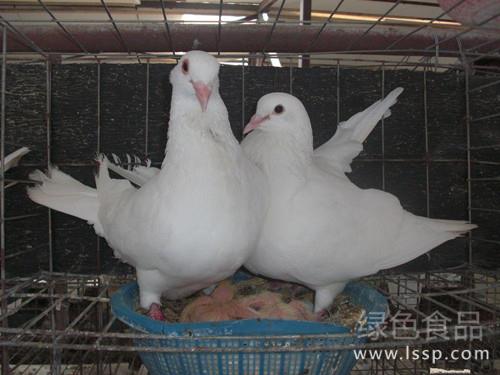
Meat pigeons
Base it on feeding standards
Up to now, no feeding standards for pigeons have been published domestically or abroad; what exists are only some empirical formulas or typical daily ration formulas. Therefore, the formulation of pigeon daily rations can only be based on these formulas. Because the commonly used feeds for meat pigeons are mainly grains and legume seeds, after the daily ration is formulated, calculate according to the feed chemical composition analysis table whether the protein content is within the range of 12%~14% or whether the nutrient ratio is a medium nutrient ratio; as long as the protein content of the daily ration meets the requirements, other nutrients generally will not fail to meet the requirements.
Control crude fiber and volume
The crude fiber content of a pigeon daily ration should not exceed 5%. Pigeons need much nutrition, but they consume 30 grams to 60 grams of feed per day, sometimes including the amount of feed given to squabs, so the volume of the daily ration should not be too large either. If the daily ration is formulated mainly with grains and legume seeds, these two points are very easy to control. If powder bait is made from bran, cake meal, and the like, attention should be paid to the selection of raw materials.
Diversify feed types
Do not use only one or two kinds of feed; otherwise, it is difficult for the formulated daily ration to have relatively high and comprehensive nutrition, difficult to bring into play the complementary effect of various nutrients, and difficult to have relatively high digestibility, palatability, and production efficiency.
According to the practical experience of pigeon keepers, as few as three or four kinds of grains and legume seeds can achieve the goal. Of course, if the aim is to broadly develop feed sources, reduce the amount of peas and corn.
Good quality
A well-formulated daily ration should have good palatability, be convenient to feed, contain no harmful, toxic, moldy, or contaminated substances, and contain no pathogenic bacteria or parasite eggs.
Make as much use as possible of locally produced, low-priced feed; pigeon farms with the conditions can also establish feed bases and produce some feed themselves. In this way, feed costs can be reduced, a reliable feed supply can be ensured, and it can also be safer in terms of epidemic prevention and hygiene.
Keep it relatively stable
After the daily ration is formulated, even if it has been proven by practice to have very high production efficiency, it should still be properly adjusted or reformulated according to changes in season, feed supply, feed prices, production level, and so on; however, changes must not be too many or too great, and it must be kept relatively stable. When a relatively large change is necessary, a transitional daily ration for short-term use can be arranged in advance to avoid causing digestive system diseases in meat pigeons.