Artificial breeding technology for yellow catfish (Pelteobagrus fulvidraco), which is easy to farm and has promising market prospects
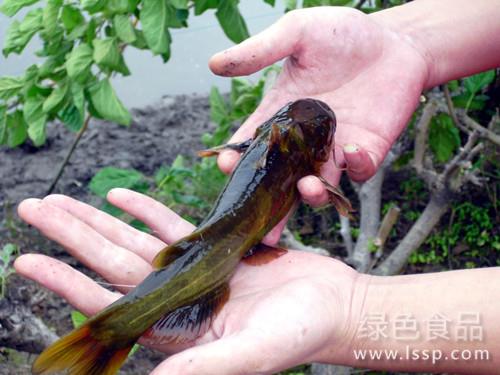
Yellow catfish
1. Pond conditions: Yellow catfish has low requirements for pond conditions, and small scattered ponds with an area of 1300-6000 sq m can all be used to farm yellow catfish. The pond requires an adequate water source, and the water quality must meet aquaculture water standards; convenient water intake and drainage, a flat pond bottom, and a water depth of about 1.5 m. Aeration equipment should be installed at 0.2 kW/667 sq m to ensure that oxygen deficiency does not occur throughout the farming process.
2. Preparation before stocking: Before releasing fry, both new and old ponds must be cleaned and disinfected. Old ponds should have excess mud removed, and generally a thickness of 10 cm is retained. Use 100-150 kg of quicklime per 667 sq m for dry pond clearing, mixing the pond bottom soil with the quicklime as much as possible to thoroughly kill pathogens and wild trash fish. After exposing to the sun for one week, add water to 80 cm, and a 30-mesh fine net should be installed at the water inlet for filtration to prevent wild trash fish from entering. Apply fermented organic manure (made by mixing livestock and poultry manure with quicklime and phosphate fertilizer and composting until fermented) to fertilize the water quality, with a dosage of 150-200 kg per 667 sq m; old ponds may appropriately reduce the amount.
3. Fry stocking: The market prospects for large-size commercial yellow catfish have always been promising, therefore large-size fingerlings should be selected for grow-out rearing, with a size of about 30 g/fish and a stocking density of 1500-1800 fish per 667 sq m. To make full use of the aquaculture water space, silver carp and bighead carp, which do not conflict in ecology and feeding habits, can also be polycultured. The stocking size is 50 g/fish, and the stocking density is 200 fish per 667 sq m (150 silver carp and 50 bighead carp). Generally, they are released in late April each year, and the polycultured silver carp and bighead carp fingerlings should be released half a month after the yellow catfish enter the pond.
4. Feed feeding: Feed formulation: Yellow catfish in natural waters mainly feeds on small shrimp, small fish, fish eggs, some aquatic insects and aquatic plants, etc. In artificial farming, fresh live animal bait can be fed. In recent years, the use of compound feed for domestication has achieved success, proving that artificial compound feed can completely replace live bait for grow-out rearing of yellow catfish. Artificial feed is made from imported fish meal, meat and bone meal, blood meal, soybean meal, rapeseed meal, dried fish worms and other raw materials combined with feed additives. The protein content of the early-stage feed is above 34%, and fat 4%; in the later stage, small trash fish meal can replace part of the imported fish meal, with a protein content of 30% and fat 6%. The feed fed must be fresh, free from mold and rancidity.
Domestication feeding: Wild yellow catfish hide by day and come out at night, preferring to forage at night. Under artificial rearing conditions, after 5-7 days of domestication, they can be trained to come to the feeding platform to eat during the day. Artificial feeding domestication is carried out 2 days after the fingerlings enter the pond, and a fixed signal is used during feeding, with feeding at fixed points and fixed times. After 5-7 days of patient domestication, they can feed normally; if domesticated fingerlings are released, normal feeding can be carried out on the second day after the fingerlings enter the pond. There are two feeding methods: manual feeding and mechanical feeding.
Feeding amount: The feeding method during the entire rearing period can be divided into three stages: The first stage is from May to June, feeding 3 times a day, with a daily feeding rate of 3%-5%; the second stage is from July to September, feeding 3 times a day, with a feeding rate of 2%-3%; the third stage is after October, feeding 2 times a day, with a feeding rate of 2%. The specific feeding amount should be adjusted according to weather and water quality conditions. In the first and third stages, it is recommended to use the satiation method, that is, stop feeding after 90% of the fish that came to the platform to eat have left the platform; in the second stage, because the weather is hot and water quality fluctuates easily, it is recommended to feed to “90% full”, that is, stop feeding after 80% of the fish that came to the platform to eat have left the platform.
In addition, yellow catfish has a relatively large mouth opening, so the feed particle size should be correspondingly increased. The particle size of the opening feed is 2.0 mm, and the particle size of the grow-out feed can reach more than 5.0 mm. Choosing to feed floating feed can improve feed utilization. If sinking hard pellet feed is fed, the pellets are required to remain stable in water for 15 minutes.
5. Water quality management: In the yellow catfish rearing process, water quality management is key. From May to June, fresh water should be added by 30 cm each month, and from June to September, 15 cm of water should be exchanged every half month, keeping the water depth at 1.2-1.5 m. From June to September, insist on applying 10-15 kg of quicklime per 667 sq m, mixed with water into a solution, and splashing it over the whole pond once every 15-20 days to purify and disinfect the water quality and reduce organic suspended matter. Every half month, use 5 kg of quicklime (or 2 kg of bleaching powder) for a local treatment once near the feeding area and the aerator. Insist on observing the phytoplankton composition and algae concentration in the water body, determine the amount of inorganic fertilizer (urea, superphosphate, potassium dihydrogen phosphate, etc.) according to the pond water color, regulate water fertility, and maintain transparency at 30-35 cm; according to dissolved oxygen level, weather, water quality and other conditions, flexibly and timely use the aerator; on sunny days, insist on running the machine for 1-2 hours in the early morning and afternoon, and in rainy, cloudy and muggy weather, extend the aeration time so that the dissolved oxygen level remains above 3 mg/cubic m.
6. Disease control: Yellow catfish has relatively strong disease resistance. As long as water quality is controlled strictly according to requirements and routine disinfection and prevention are done well, diseases generally rarely occur. Yellow catfish is a scaleless fish, and its tolerance to commonly used drugs is less than that of scaled cyprinid fish. Therefore, prevention should be given priority, and highly effective, low-toxicity drugs should be used as much as possible during treatment. Regularly add Chinese herbal medicines, photosynthetic bacteria, immune polysaccharides, multivitamins and other drugs to the feed to make medicated bait for feeding, which can enhance the physique of yellow catfish, improve the body's disease resistance, and reduce the occurrence of diseases. During fishing, stocking, transportation and other operations, try to avoid injuring the fish body to prevent infection by water mold. For diseased fish already infected with Chilodonella and Trichodina, accurately use 0.7 mg/cubic m of a copper sulfate and ferrous sulfate mixture for splashing treatment. In high-temperature seasons, if hemorrhagic edema disease occurs, continuously use chlorine dioxide to splash the whole pond 2 times, and at the same time feed medicated bait; the treatment effect is relatively good.