Wild boar meat has good flavor and strong market prospects; four key points for raising them in captivity
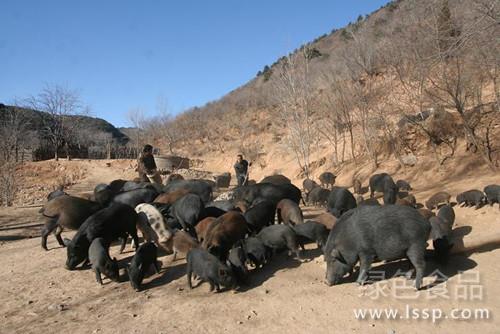
Wild boar farming
I. Feeding wild boar:
Put male and female wild boars into pens for artificial domestication. Wild boars are timid and afraid of people at first. To change this weakness, when raising them artificially, small wild boars are generally purchased for domestication, mostly weighing 10 kg to 22 kg, because at this time the wild boars are not old in months, are easy to tame, and are highly adaptable.
During the taming process, the wild boar is an omnivorous animal and is generally fed twice a day like domestic pigs. Because of its wild habits, it is good at eating raw food. Common farm foods such as tender corn, red sorghum, winter melon, potato (Irish potato), sweet potato, peanut vines, sweet potato vines, grain ears, pumpkin, eggplant, fresh mulberry leaves, fresh vitex leaves, black locust leaves, carrots, white radish, Chinese cabbage, fallen apples, pears, and persimmons are all foods it likes to eat. At the beginning of domestic feeding, it should be fed with raw food. After one month, mix half raw food and half feed for domestic pigs, such as cornmeal, bran, tofu residue, and starch residue; add an appropriate amount of salt, mix it in and feed it, so that it slowly changes its habit of liking raw food. After the wild boar has basically adapted to the penned environment, it can then be fed with domestic pig feed, but some root and leaf plants should also be added appropriately.
II. Pen construction:
Wild boar pens are best chosen on higher ground, easy to drain, and convenient for light and ventilation. The original domestic pig pens can also be used for raising them after slight modification. For newly built pens, the outer chamber requires a cement floor. The pen requires the inner chamber and outer chamber to be matched. The inner chamber is for the wild boar to sleep and give birth, about 3 m long and about 2.8 m wide. The pen should be roofed, built in the style of a general pig house, covered with tiles or a roof woven from wheat straw. The outer chamber is for the wild boar to defecate, eat and drink, move around, and sunbathe, about 3 m long and about 2.8 m wide. The surrounding wall should be faced with cement, with a building height of 1.7 m-1.8 m. A drinking water pool can be built at the base of the wall where drainage is convenient, using a brick-stone-cement structure, 1 m long, 0.5 m wide, and 23 cm deep. It should be noted that the drinking water pool should not be built too deep or too narrow; otherwise, when the summer weather is hot and the pigs lie in the pool to cool off, it will cause suffocation and stillbirth in pregnant sows. A 1 m wide passage should be left between the inner chamber and the outer chamber to facilitate the wild boars' free entry and exit. The pen door is generally left at the front of the inner chamber.
III. Breeding techniques:
The wild boar has coarse and sparse hair, generally gray or grayish yellow. Adult sows weigh 90 kg-130 kg and are sensitive to the external environment. Female wild boars generally have 6 pairs to 7 pairs of teats, produce 2 litters per year, and generally 8 to 14 piglets per litter. The suitable breeding time is from 7 months to 8 months after birth, at a body weight of 40 kg-60 kg. When female wild boars are in estrus, the principle is generally to mate first-litter sows early and multiparous sows late. When wild boars are in estrus, the external genitalia are obviously red and swollen. When the external genitalia change from red to dark purple, from swollen to slightly wrinkled, or when the sow stands still after pressing her rump with the hand, this is the best time for mating. During mating, the mating time for male and female wild boars is about several minutes, slightly longer than that for domestic pigs. According to experience, it is best to use repeat mating, that is, mating again after an interval of 6 hours to 8 hours. This can significantly increase the sow's conception rate. When the female wild boar is in estrus and suitable for mating, the method of driving the boar into the sow's pen for 1 day to 2 days can also be used; at this time, the male wild boar can mount and mate multiple times at night. After confirming successful mating, drive the male wild boar out. After 20 days, observe again whether the female wild boar is still in estrus. The estrous cycle of female wild boars is generally 18 days. If she is not in estrus, it proves that the wild boar has mated successfully.
IV. Breeding stock selection:
Farms and households engaged in wild boar farming must have 1 to 2 purebred wild boars. As the saying goes: a good sow benefits one litter; a good boar benefits a whole slope. This shows the importance of the breeding boar. Choosing a good breeding male wild boar is of vital significance to the quality of the offspring. Generally, purebred male wild boars with a long body, tall legs, and a pointed snout, conforming to wild boar characteristics, are selected as breeding stock. If the offspring produced by special wild boars crossbred from wild boars and domestic pigs are kept for breeding, the offspring bred will show atavism, that is, some of the produced pigs will look partly unlike wild boars and instead like domestic pigs. Therefore, two-way crossbred special male wild boars are not suitable for use as breeding stock. If restricted by conditions and a special wild boar must be used as a breeding boar, then a three-way crossbred special wild boar with more than 70% wild boar bloodline should also be selected as breeding stock, and in terms of blood relationship, inbreeding must also be prevented. In this way, the offspring will have strong disease resistance and grow quickly.