Water Grass Cultivation Techniques in River Crab Ponds: Water grass provides food and shade to escape the summer heat
In the process of pond-culturing river crabs, the quality of water grass plays a very large role. It mainly serves to purify water quality, increase dissolved oxygen, provide shade to escape the summer heat, offer shelter from enemies during molting (reducing cannibalism), provide food, provide habitat, improve the substrate, and lower water temperature to avoid or reduce precocious sexual maturity in river crabs. Therefore, the growth state of water grass determines the size, quality, yield, and economic benefits of river crabs. It can be seen that water grass is crucial for ecologically healthy river crab farming. Below are a few observations on water grass cultivation:
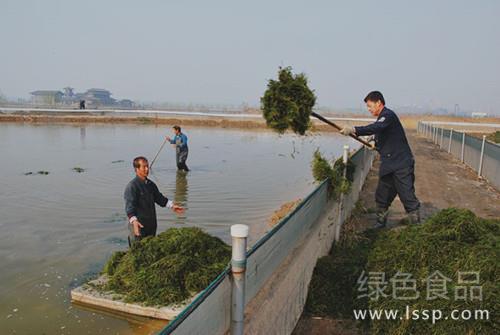
Planting water grass in river crab ponds
1. Selection of water grass varieties.
① Water grass varieties for crab ponds include Elodea, hornwort, tape grass, water spinach, Hydrilla verticillata, duckweed, etc. The water grass suitable for early stocking in crab ponds is Elodea (Elodea tolerates low temperatures, sprouts early, grows fast, and crabs like to eat it), but when the water temperature is above 30°C, it easily rots and spoils the water quality, so it is a transitional water grass and its planting area should not be too large. The other water grasses are all tolerant of high temperatures, have long growth periods, good adaptability, strong regeneration ability, and are favored by river crabs, making them the main water grasses in the pond during the middle and late stages.
② The pond should not have only a single variety of water grass; submerged and floating water grasses should be combined in multiple varieties so that river crabs have palatable water grass at different growth stages. Plant Hydrilla verticillata in deep-water areas, tape grass in shallow-water areas, and Elodea in transitional areas, which helps the balanced growth of pond water grass, maintains suitable density of water grass, with the water grass area accounting for 40% of the pond surface, ensuring smooth water flow, allowing river crabs to move freely, facilitating the flow of pond water, and helping to increase the oxygen dissolved in the water from the air.
2. Cultivation of water grass .
① Elodea is suitable for planting in February when the water temperature is above 5°C and when the pond water depth is about 10cm, after the quicklime pond-clearing treatment has lost its potency. The specific method is: cut the stems into 10-15cm lengths, insert 5-10 stems as a bundle into the mud to a depth of 3-5cm, at a rate of 20 kg/mu. After the grass survives, add water to submerge the Elodea by about 10cm.
② Hydrilla verticillata is suitable for planting in May. The specific method is: throw whole plants into the water at 200 kg per mu. Some water grass is eaten by crabs, and some water grass gets mud on it, grows fibrous roots, and grows.
③ Tape grass is sown in shallow water with seeds (100 g/mu) around Qingming; hornwort is transplanted as whole plants in May (200 kg/mu).
3. Management and protection of water grass. Fertilize the water at low temperatures to create a good water environment, promote water grass rooting and growth, help increase the survival rate of juvenile crabs, and help reduce the growth of moss. During the growth process, according to the growth condition of the water grass, promptly splash fertilizers that promote strong roots and grass growth. To further improve the management and protection of water grass, the specific methods are:
① In the early stage of water grass planting, juvenile crabs should be temporarily kept inside enclosures, and only when the water grass grows normally should the river crabs be released, which helps the growth of water grass.
② Water level regulation: The water level should follow the principle of "shallow in spring, full in summer, moderate in autumn." In summer, the water level should not be too deep, generally not exceeding 2 m, preferably around 1.5 m. If it is too deep, water grass cannot photosynthesize well, the roots easily rot, and water quality deteriorates.
③ Water quality regulation: The water should not be turbid. Mud and suspended matter in the water easily stick to the water grass, which is not conducive to photosynthesis and causes the water grass to turn yellow and die. Quicklime slurry and microecological preparations should be used to purify the water quality, making the water body clear with high transparency and maintaining strong photosynthesis in the water grass.
④ Topdressing: If the water grass grows poorly, amino acid fertilizers should be used to promote root growth, thereby promoting the growth of the whole plant. ⑤ When the water grass grows vigorously and emerges above the water surface, the grass tops should be cut off in time to keep the water grass 10-15cm below the water surface. If it is too dense, excess water grass should be removed, and rotten grass should be cleared in time to avoid spoiling the water quality.
⑤ If river crabs are observed pinching the grass, feed containing trace elements and vitamins should be provided in time, and fresh snails, wheat, corn, and fresh water grass should be fed in time; this can alleviate the problem of river crabs pinching the grass.