Detailed Guide to Cherry Barb Care and Breeding Methods
The cherry barb (Barbus titteya Beraniyagala) taxonomically belongs to the family Cyprinidae, subfamily Barbinae. Because its overall base color is rose red, it is called the red rose fish; and because during spawning the male develops a nuptial color as vivid as a newly opened cherry blossom, it also has names such as cherry barb and cherry carp. Its English names include Cherry barb and Crimson carplet.
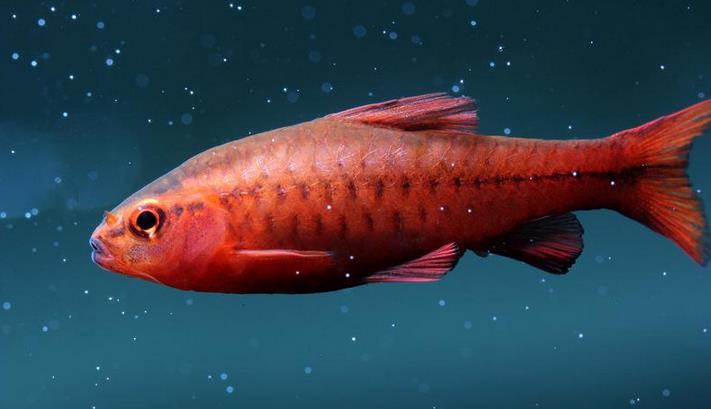
The cherry barb is native to Sri Lanka and is a small tropical fish. This fish is small and exquisite with vivid colors; apart from the jagged golden line along the lateral line, its entire body is cherry red. If the aquatic plants in the aquarium are arranged appropriately, together with suitable lighting, the colors on the fish's body are especially alluring, presenting a light coffee color depending on factors such as health and environment, and sometimes turning peach green; if the rearing environment is poor, the body color is rather plain. On each side of the body, at the center, there is an irregular broad band in two colors, gold and black, running from the tip of the snout through the eye all the way to the caudal peduncle, and above it there is another jagged golden stripe starting from the orbit, interlocking in a sawtooth pattern with the black stripe below it, extending to the caudal peduncle. Above these two longitudinal stripes, the back is darker in color, appearing reddish brown. All fins are red. The iris of the orbit is silvery white and can emit a pearly iridescence.
The male and female cherry barbs have distinct features. The male's body color is relatively vivid, especially during the breeding season. When the male is in spawning condition, its body color is cherry red, very striking, and the longitudinal band on the body often fades; the female always retains its original color, and the brown longitudinal band on its body also remains unchanged. The female is relatively plump in shape, with a swollen abdomen.
> Rearing Methods
In the natural environment, cherry barbs inhabit shaded areas of small rivers or streams; when kept in an aquarium they are easily startled, and when sounds are too loud they timidly hide. Therefore, it is best to plant some aquatic plants in the aquarium so that they have a hiding place and avoid being startled.
When healthy and in normal condition, cherry barbs are lively, fond of chasing and jumping, and sometimes leap out of the water. To prevent the fish from jumping out of the tank, the aquarium must have sufficient space, leaving room for the fish to swim and play; and the tank must be covered with a lid.
Males have a competitive disposition, but they do not fight. When two males are placed together with a female, the males will each spin around, intensifying their own nuptial color, competing in splendor, showing off their gorgeous colors to win the female's favor.
Cherry barbs swim agilely, fear strong light, and often move in the middle and lower layers among the aquatic plants, so the lighting of the aquarium should be kept dim, and some aquatic plants should be planted to reduce the strong light. They have strong adaptability to the environment and can tolerate relatively low dissolved oxygen; they grow well at water temperatures of 22-30°C, with the optimum water temperature being 23-25°C.
In terms of feeding habits, they mainly feed on small zooplankton. Their mouths are as small as cherries, and they are not good at competing for food, so when feeding, fine bait should be used, especially at the juvenile stage, when it is advisable to feed the specially cultured artificial bait "infusoria water" (containing a relatively high density of tiny plankton, including Difflugia, Paramecium, etc.), and each feeding should take a long time.
> Breeding Methods
The cherry barb is an egg-laying fish. Because of its small size, its spawning quantity is also small, and the survival rate of the fry after hatching is relatively low, especially during the first week, when they often die prematurely due to water temperature, insufficient food, and other reasons.
1. Selection of parent fish
Those with a total length of more than 4 cm, intact body shape, lively and healthy swimming, a plump abdomen in the female, and a fresh peach-red body color in the male can be selected as parent fish.
2. Preparation before breeding
The aquarium used for breeding must be washed clean in advance, and some soft, fine aquatic plants such as foxtail, goldthread grass, or duckweed should be planted so that the eggs laid can adhere to the leaves and roots of the aquatic plants. Pairing male and female requires a process of mutual adaptation; even cherry barbs raised in the same aquarium will bite and injure each other when paired in the same breeding aquarium. A glass partition can be placed in the breeding aquarium to keep males and females separately; after they become familiar with each other, the partition can be removed to let the parent fish mate.
The size of the breeding aquarium is 60×20×20cm, the water hardness is 7-9 degrees, the pH is 6.6-6.8, the water temperature is maintained at 25-27°C, and the aquarium is placed in a dimly lit place.
3. Spawning
After everything is arranged, in the evening put carefully selected parent fish into the breeding aquarium at a male-to-female ratio of 1:1. The male parent fish in spawning condition will show a more vivid red nuptial color than usual, excited and active, chasing and playing, often splashing water everywhere, and even leaping out of the water. The breeding habits of the cherry barb are the same as those of other fish of the genus Barbus; usually, after a period of chasing in a dim environment, the parent fish begin to spawn and release sperm side by side. The fertilized eggs have a specific gravity slightly greater than water and adhere to the aquatic plants as they sink.
After spawning, the parent fish have the habit of eating the eggs, so as soon as mating begins, close attention should be paid. After each mating, feed a small amount of live bait as soon as possible to distract the parent fish and reduce the eggs being eaten; when spawning and sperm release have completely stopped, remove the parent fish in time. The female lays about 50-200 eggs each time, and the number of fry that hatch is even smaller. During the spawning period, the interval between each spawning of the parent fish is about 10d.
4. Rearing the fry
At normal temperature, the fertilized eggs hatch after about 24h, and the fry hang head-down under the leaves or at the roots of the aquatic plants for about 1d, then begin to swim and feed on the third day. At first they are fed "infusoria water," and after 10d they are switched to small fish worms. After that, as long as they are carefully looked after and fed, they can grow safely and quickly.