Forage grass planting cannot be done carelessly; quite a few cattle farmers have stumbled over this
Raising cattle requires a large amount of roughage resources, which generally come mainly from crop straw or wild weeds, but the former is usually of poor quality while the latter has certain limitations, so quite a few cattle farmers have thought of planting forage grass artificially. Growing grass to raise cattle is not as simple as everyone imagines; there are numerous forage grass varieties with different characteristics, and you must choose forage grass suitable for local planting to succeed!
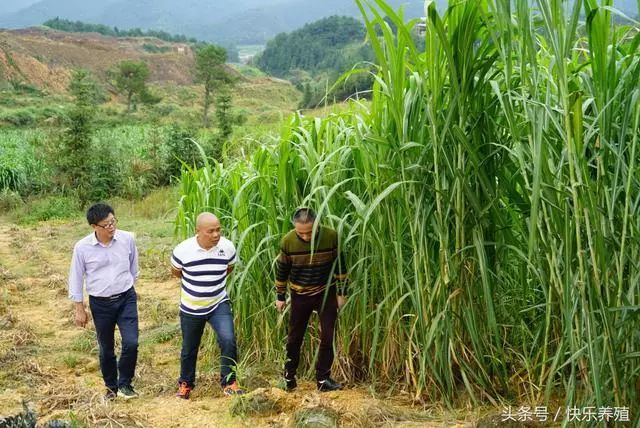
1. Hybrid Pennisetum (Pennisetum hydridum)
Hybrid Pennisetum is a perennial grass-family forage grass, named for its long leaves, tall stems and bamboo-like stalks. It is suitable for planting in the vast majority of southern regions, and in recent years some northern regions (such as Shandong, Henan, Beijing, Hebei) have successfully trial-planted it, but overwintering remains a major obstacle so it has not been promoted on a large scale. Hybrid Pennisetum is propagated using seed nodes; in frost-free winter areas it can be planted in all four seasons, generally with March to June as the best planting period, at about 2000-3000 plants per mu. The harvest period of Hybrid Pennisetum is generally from March to December; with proper water and fertilizer management, it can be cut green once every 40-60 days, for a total of 5-7 green cuts per year, yielding about 15-20 tons of fresh grass per mu.
Forage grass varieties similar to Hybrid Pennisetum include sweet elephant grass, red elephant grass and giant juncao, which will not be introduced one by one here.
2. Ryegrass
Ryegrass is a grass-family forage grass similar to wheat, including Wintergrazer 70, annual ryegrass, perennial ryegrass and Italian ryegrass, etc., and can be planted in most areas of China. Ryegrass is propagated using seeds, divided into autumn sowing (September-October) and spring sowing (March-April), generally with autumn sowing being best. Ryegrass has strong frost resistance, and quite a few cattle farmers all believe that ryegrass can grow normally in winter, but this is actually not the case; generally when the temperature drops below 10°C growth is hindered, and when the temperature drops below 5°C growth stops. Here it is suggested that friends planning to use ryegrass to raise cattle in winter must give up this idea as early as possible. Generally, with early autumn sowing, 1 cut can be harvested before winter begins, and 2-3 cuts can be harvested before midsummer, with a per-mu yield of up to 8000-10000 kg; spring sowing can harvest 1-2 cuts, with a per-mu yield of up to 2000-4000 kg.
3. Mexican corn grass (Euchlaena mexicana)
Mexican corn grass is an annual grass-family forage grass that looks very much like corn, with a plant height of up to 3-4 m, strong tillering ability, and 30-60 branches per clump. It can be planted in most areas of China. Mexican corn grass is propagated using seeds, generally sown in February to April, with a growth period of 180-240 days. Generally, with proper water and fertilizer, it can be harvested 7-8 times, with a per-mu yield of up to 5-10 tons.
4. Sudan grass
Sudan grass is an annual grass-family forage grass similar to sorghum, and similar types include Sorghum-Sudan grass and sweet sorghum (Hercules), etc. It can be planted in most areas of China. This type of forage grass is mainly propagated using seeds, generally sown in February to April, and can be harvested 3-4 times per year, with a per-mu yield of up to 5-10 tons. However, the seedlings of this type of forage grass contain a large amount of hydrocyanic acid, and cattle are prone to poisoning after eating it, so it is best to wait until it has grown to more than 1 m before harvesting.
5. Pennisetum (Pennisetum)
Pennisetum is a perennial grass-family forage grass with the characteristics of drought tolerance, moisture tolerance, shade tolerance, cold tolerance and trampling tolerance, and is suitable for planting in most areas of China, generally best planted in mountainous and hilly areas that need grazing. Pennisetum is mainly propagated using seeds, generally sown in April to June, and can be used for grazing or harvesting, with 3-4 harvests per year and a per-mu yield of up to 4-7 tons.
6. Alfalfa (Medicago sativa)
Alfalfa is a perennial legume-family forage grass, rich in protein and various vitamins, so it is also called the “king of forage grasses”. It is suitable for planting in most areas of China, with more planting area in Inner Mongolia, the northwest and other regions. Alfalfa is propagated using seeds, divided into autumn sowing (August-September) and spring sowing (March-May), and can be harvested 3-4 times per year, with a per-mu yield of 4000-8000 kg of fresh grass or 1200-2400 kg of hay, among which the first-cut grass has the highest nutritional value.
Combined planting of forage grasses
For combined planting of forage grasses, you first need to consider the environment and yield, and then on this basis consider nutritional value and nutritional diversity. In southern regions, it is suggested to mainly use Hybrid Pennisetum, combined with planting some ryegrass and Mexican corn grass, etc.; in northern regions, it is suggested to mainly use Mexican corn grass, combined with planting some ryegrass and Sudan grass, etc.; in northeast and northwest regions, it is suggested to mainly use ryegrass or Sudan grass, and then combined with planting some alfalfa and Mexican corn grass, etc.; in mountainous or hilly areas that need grazing, it is suggested to combine planting some trampling-tolerant forage grass varieties such as Pennisetum, clover and Leymus chinensis.
As winter arrives, in order to prevent the harm of low-temperature freezing disasters to livestock production, farmers should adopt the following five measures to ensure the safety of livestock overwintering.
First, grasp winter grass storage.Organize expert groups to go deep into the farms (zones) and farming households of every township in the county, guide them in deep processing of forage and feed, store forage and feed in good time, improve the utilization rate of forage and feed, and ensure the supply of forage and feed.
Second, grasp the warmth preservation work of livestock sheds.Organize farming households to adopt methods such as padding thick rice straw and shielding livestock sheds from wind, to improve livestock's ability to resist cold weather.
Third, grasp the prevention and treatment of livestock diseases.According to the requirements of “the county not missing a township, the township not missing a village, the village not missing a household, the household not missing livestock and poultry, and livestock and poultry not missing a needle”, actively carry out livestock immunization and disinfection and source elimination work, to ensure that no epidemic outbreak occurs.
Fourth, grasp animal epidemic monitoring.Formulate emergency plans, keep abreast of animal epidemics and animal monitoring dynamics after low-temperature freezing disasters occur, and ensure that once an epidemic (disaster) is discovered, it is handled promptly according to the “early, fast, strict, small” method.
Fifth, grasp the work of livestock going to market.On the premise that the proportion of high-quality breeding female livestock is not reduced, timely guide farming households to seize the Spring Festival meat consumption season, cull sick and weak livestock, reduce forage and feed pressure, and reduce disaster losses.
In winter, due to lack of grass and cold, it is often easy to cause farm cattle to be weak in constitution and decline in resistance and then die. In order to ensure that farm cattle overwinter safely, farmers should do the following four protective measures well:
First, repair the cattle shed well and pay attention to ventilation and warmth preservation.The farm cattle shed must be repaired so that it does not leak rain from above, is not drafty from the sides, and the ground is not damp; the ground should be padded with grass, so as to play a role in cold prevention and warmth preservation. Avoid drafts blowing in, promptly remove farm cattle manure and urine, frequently add and change bedding grass, keep the pen clean and dry, and ensure the cattle shed temperature is above 10°C. Pay attention to the daily lighting of farm cattle; 1-2 60-watt or 100-watt light bulbs can be installed in the cattle shed to increase lighting for the farm cattle in the morning and evening. At noon on clear days, properly open windows and doors for ventilation, and keep the air in the shed fresh.
Second, skillfully supplement concentrated feed and pay attention to balanced nutrition.Because winter forage is withered and brown, farm cattle often cannot eat enough when grazing, so in addition to feeding roughage such as rice straw, it is also necessary to supplement a sufficient amount of concentrated feed, and add bran rice porridge, root-tuber feed and mineral feed. Generally, each adult cattle should be supplemented daily with 1.5-2 kg of concentrated feed, 10-20 g of bone meal, and 10-15 g of salt. For thin and weak farm cattle, often feed some distillers' grains to increase energy. Feed enough warm water 2-3 times a day to ensure the water needed by farm cattle for digesting roughage and for internal circulation.
Third, look for opportunities to graze and pay attention to persisting in letting farm cattle exercise.In winter, at noon on clear and warm days, choose a place sheltered from the wind and facing the sun for grazing, letting farm cattle eat while basking in the sun and increasing the amount of exercise, which can let out moisture and disperse internal heat, promote blood circulation and metabolism, enhance cold resistance, and strengthen the constitution of farm cattle.
Fourth, attach importance to disinfection and pay attention to disease prevention and treatment.Cattle sheds and utensils must be regularly sprayed and disinfected with 10% quicklime water or 30% plant ash water. Carry out targeted deworming work inside and outside the body of farm cattle; deworming should be done promptly before winter begins, and the deworming drug is best chosen as chlorsulon combined with fenbendazole; this group of drugs can simultaneously expel parasites inside and outside the body of farm cattle, with remarkable effects in preserving and increasing body condition. Do a good job in preventing foot-and-mouth disease in farm cattle; inoculate each cattle with 3 ml of cattle foot-and-mouth disease type O-Asia I bivalent inactivated vaccine to improve the body resistance of farm cattle. Observe more at ordinary times, and promptly diagnose and treat farm cattle when they are found to be ill.
(Gucheng County Animal Husbandry and Veterinary Bureau, Hubei Province Liu Xiaowu Postal code: 441700)