Analysis of the Milk Powder Industry: Intensifying Competition Due to Declining Birth Rate
Judging from the birth rate statistics released this year, the domestic infant milk powder market is ushering in new changes, and the sales gap between domestic and foreign-funded milk powder brands is gradually narrowing. What is going on here? Let's take a look below.
One year after the implementation of what is called the "strictest milk powder new policy in history," the pace of formula registration approval has slowed markedly. According to statistics, a total of 255 new formula series were added in China in 2018, and industry estimates suggest that more than 500 formulas are still awaiting approval. The tightening of the formula registration system is widely interpreted as being intended to boost national brands.
"But if calculated by sales, foreign brands still have the advantage." On February 21, dairy expert Song Liang told the 21st Century Business Herald in an interview that the domestic infant milk powder market is worth about 110 billion yuan, of which foreign brands account for roughly 60% and domestic brands 40%.
Song Liang believes that the impact of the declining birth rate on the industry will become prominent this year, competition among milk powder brands will become further white-hot, and major companies are all pushing toward high-end differentiation. It cannot be ruled out that a price war may once again emerge in the market.
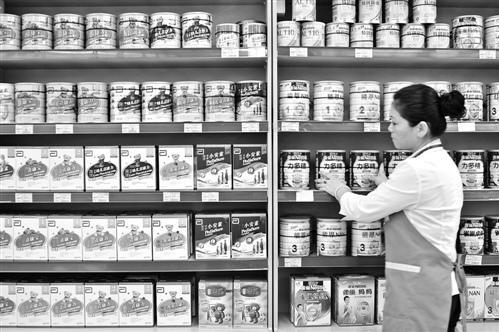
Intensifying competition:
Data from the National Bureau of Statistics show that last year China's number of newborns was 15.23 million, a full 2 million fewer than in 2017, and the birth rate was 10.94‰, down 11.99% year on year. Goldman Sachs Gao Hua Securities pointed out that, considering the decline in births, infant formula milk powder sales are expected to be basically flat this year, and by 2020 sales will fall by 2%.
"Most babies generally start drinking stage 2 formula, because breastfeeding usually lasts six months, sometimes a year, so children born in 2018 have a relatively large impact on milk powder sales in 2019." In Song Liang's view, last year's decline in the birth rate is not an isolated case. He judges that the total number of newborns across China will show a continuous declining trend in the future, which will bring a certain impact on the overall demand in the domestic infant milk powder market.
"The disappearance of the demographic dividend and intensifying industry competition are a huge challenge for any domestic dairy company." pointed out Zhu Danpeng, a food and beverage industry researcher at the China Brand Research Institute.
In fact, the infant milk powder registration system implemented last year has already eliminated a large number of small and medium-sized brands. Under the dual impact of a continuously declining birth rate and the ongoing advancement of the new dairy policy, Song Liang believes that competition in this year's milk powder market will mainly revolve around "locking in" distributors, the high-end market, marketing methods and formula upgrades.
"Since last year, everyone has begun frantically competing for distributors, and 2019 will continue this. Second, competition across the entire market will intensify, and it cannot be ruled out that some unpredictable results may appear in high-end products as well, such as price wars. Third, in terms of overall marketing, everyone is learning from each other, but large companies will, through market and marketing means, gradually wash out some small companies and small brands." Song Liang said.
The industry expects that if formula registration changes are implemented this year, 2019 is expected to become the year with the most formula registrations and formula change upgrades. "Everyone is looking for product differentiation, because homogenization of high-end products is now very serious, so they need to play the differentiation card, and formula upgrades will be a big hot topic recently." Song Liang judged.
Reckitt Benckiser Chief Financial Officer Adrian Hennah pointed out at an earnings meeting that although China's number of new births last year decreased compared with the previous year, this impact was offset by the premiumization trend in the milk powder market. "China has some very strong growth points." Goldman Sachs Gao Hua Securities pointed out that in 2018 the share of premium infant formula milk powder in the overall market reached 23%, with growth faster than other subcategories, and that future premiumization of consumption and upgrading of product structure will become an important force driving growth in the milk powder industry.
Fierce market slaughter is about to break out, and the industry expects that the domestic milk powder market will see greater consolidation this year. Song Liang told reporters that last year the market concentration of the top 12 milk powder companies reached 70%, and this figure is expected to reach 80% this year.