What Are Mullet and Mullet Roe? Taiwan's Mullet Roe Rises to a National Competition
Do you know the mullet? The mullet, also known as the grey mullet, is a migratory fish. In the ten days before and after the winter solstice, when cold fronts arrive, mullet appear in large numbers near the Taiwan Strait to migrate and spawn. For hundreds of years this has never failed or paused, so it is called the "faithful fish."
During the Xia and Shang dynasties, that is, more than 3,500 years ago, the Chinese already began eating mullet; in the Tang dynasty, Wu Commandery's tribute included mullet and mullet roe; from the late Jiajing era of the Ming dynasty, many merchant ships and fishing boats entered Taiwan, in fact coming to catch mullet; from the Ming Zheng period to the Qing dynasty, fishermen were required to hold a fishing flag before they could go to sea to catch mullet; mullet roe production techniques were improved during the Japanese occupation period after Japanese experts came to Taiwan to provide guidance; and breeding techniques made breakthrough progress after the retrocession. The history of mullet roe production has continued to grow throughout Taiwan's long history, further combining production, processing, cuisine and art to become an important cultural heritage of Taiwan.
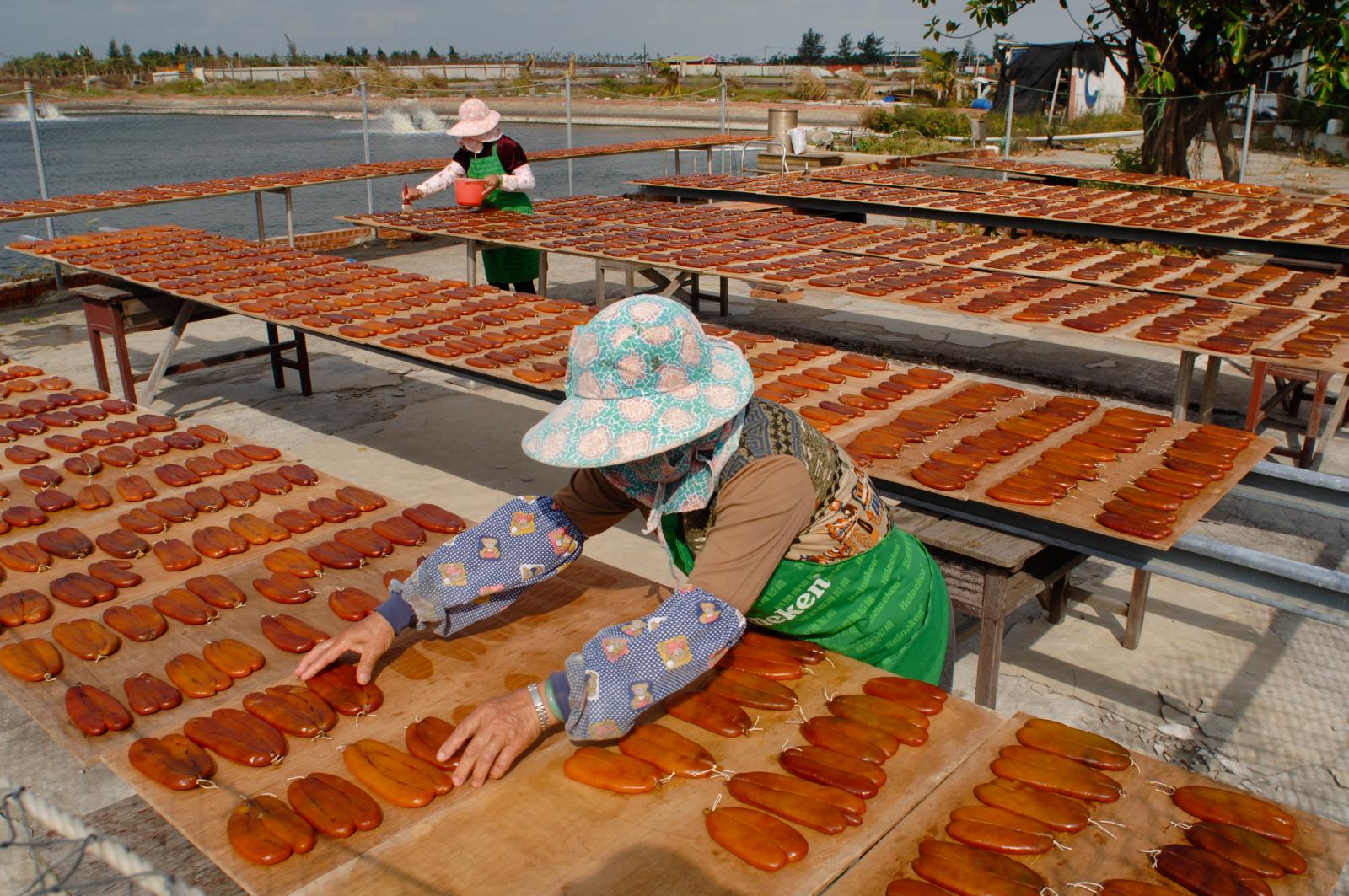
Mullet Roe Rises to a National Competition
In earlier years, mullet mainly came from ocean fishing, and it was known by the laudatory name "black gold of the sea," and was also an important catch along Taiwan's western coast. However, with the depletion of fishery resources and the impact of global climate change, the ocean-caught mullet yield has dropped sharply, and sea-caught mullet roe has created a phenomenon of "things are precious when rare." Gradually, as domestic mullet farming techniques continued to mature, farmed mullet output has exceeded wild mullet year by year, with a stable annual output of about several thousand metric tons. But the idea that sea-caught mullet roe is superior in quality to farmed mullet roe is widespread in consumers' minds. In order to change consumer perceptions and improve mullet roe processing techniques, since year 98 the Fisheries Agency has held the "Top Ten High-Quality Mullet Roe" competition and industry culture promotion every year. Past competitions have been fiercely contested from the local level onward, with many brothers, fathers and sons, or husbands and wives entering together. Those who stand out in the local competition and qualify for the national competition are all fine products. Winning the honor of the national "Top Ten High-Quality Mullet Roe" not only affirms the processor's processing techniques, but also leads the media to compete in publicizing and reporting it, further affecting the subsequent selling price and sales channels of their mullet roe. The grandeur and intensity of the annual competition are like the "Golden Horse Awards" of the aquatic products world, so farmed fishermen or processors begin rubbing their fists and preparing whenever the mullet season arrives, and businesses all aim to win each year's championship and achieve consecutive titles.
The mullet roe competition has also become a lively annual production-area event in six regions: Hsinchu, Changhua, Yunlin, Chiayi, Tainan and Kaohsiung. It not only evaluates mullet roe quality, but also combines banquets, garden parties, fish-eating education and running road races and other activities, and also crosses sectors to cooperate with domestic and international chefs, liquor merchants and hotels, developing diversified uses with mullet as the element. In year 107, Yunlin held a mullet sale and mullet feast at the plaza of the Boziliao Fishing Port Direct Sales Center; Chiayi also held the "Chiayi Strictly Selected Golden Mullet Roe Competition," using mullet roe, mullet milt, mullet gizzard and mullet shell, the "three treasures of mullet," in dishes, and carefully designed a banquet of specialty dishes, including mullet seafood thick soup, Thai-style mullet tendon, mullet roe rice cake, French mustard mullet, black pepper scallion mullet milt, mullet milk hot pot and other delicacies, while also promoting New Year holiday souvenirs; Hsinchu's "Zhubei Mullet Culture Festival" included street parade performances, fishing experiences, celebrity chef endorsements, a seafood market and stage performances; the Kaohsiung Ziguan District Fishermen's Association chose to hold its event at the plaza in front of the Lianlian Keziliao storefront, with a local mullet roe evaluation competition and a New Year goods market, fully stocked with Spring Festival candies, cakes and pastries, goods from north and south, traditional food snacks and souvenirs.