Where Is the Pitcher Plant Native To? Propagation Methods and the Digestion Principle Behind Its Insect-Eating
The main habitat of the pitcher plant is the tropical regions of Asia.Do you know about pitcher plants? Would you like to learn about them? Let's take a look together.
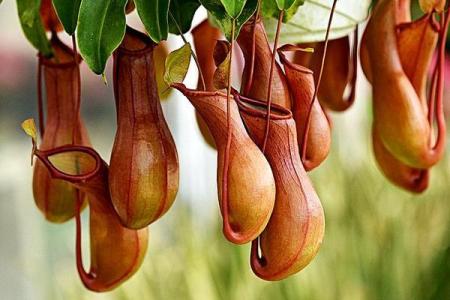
How do pitcher plants propagate?
Pitcher plants mainly propagate by "cuttings." Taking cuttings of pitcher plants is very easy, and the success rate is very high. When taking a cutting of a pitcher plant, use a knife to cut off a section of the pitcher plant's stem; the stem must have two nodes, or in other words, the stem must have two leaves. Since the new shoots of the pitcher plant grow from the nodes, if the cutting has no nodes, then no new shoots can grow. The growing medium used for pitcher plant cuttings must retain water, such as sphagnum moss or peat soil.
Since the cutting has no roots, the plant will die from lack of water. In order to prevent the cutting from losing water, the following two points must be done:
■ Reduce the leaf area
Since the leaves lose water, reducing the leaf area can reduce water loss. Therefore, part of the leaf stalk on the cutting must be trimmed off; even if the leaf stalk bears a very large, very beautiful pitcher, you must be willing to cut it off. If the cutting is too long, it will carry too many leaves and thus lose water, so it is enough for the cutting to have two or three nodes; do not make it too long.
■ Increase the environmental humidity
If the environmental humidity is very high, the water loss of the cutting can be reduced. Therefore, the cutting should be grown in a sealed environment, for example, wrapping the cutting together with the flower pot in a plastic bag, so that the environmental humidity can be raised.
Place the potted cutting in a bright place, but direct sunlight must be strictly avoided, otherwise it will be too hot. After that, after about several months, if new shoots grow from the nodes of the cutting, it has succeeded; once the leaves have grown out, it can be cared for according to ordinary cultivation methods.
Do pitcher plants flower?
Pitcher plants do flower, but getting them to flower is not a very easy matter. Pitcher plants must grow to a certain size before they will flower. However, because many pitcher plants are propagated by cuttings, the plants are not large enough, and they must be grown for several more years before they may possibly flower. In addition, there must be sufficient light and an adequate supply of nutrients to make the plant grow robust, and only then will it flower.
Pitcher plants are dioecious plants; male flowers and female flowers grow from different plants respectively. Therefore, if you want pitcher plants to set seed, you must determine the sex of the pitcher plants you have. Unless you want pitcher plants to set seed, there is no need to care too much about whether the pitcher plant flowers; the flowers of pitcher plants are not attractive, and they do not smell good, being somewhat stinky.
Why do the insects caught by pitcher plants look like they have not been digested?
The pitcher plant is a carnivorous plant that is very good at catching insects, and we can often find the carcasses of hundreds of ants in a single pitcher. However, the appearance of these insect carcasses looks fairly complete, as if the pitcher plant has not digested those insects.
In fact, these insects have all been digested, leaving only the outer shells. All carnivorous plants can only secrete protease, and this enzyme can only break down the proteins of insects. Therefore, the protein-rich tissues inside the insect body can be broken down by the protease, while the main component of the insect's outer shell is chitin, and carnivorous plants do not produce the relevant enzyme to break down this component. Therefore, after being digested, the insect still leaves behind its outer shell, creating the false impression that the insect has not been digested.