Is the sundew that eats insects a carnivorous plant? A roundup of common carnivorous plants
Carnivorous plants are a relatively little-known group of garden plants. They have insect-eating characteristics that set them apart from ordinary plants, and together with some misunderstandings, do you know which carnivorous plants there are?
Pitcher plant: the structure the pitcher plant uses to catch insects is a specialized insect-trapping pouch at the end of the leaf. The pouch contains digestive fluid, and once an insect falls in through the smooth pouch opening, it drowns and is digested. The pitcher plant's insect-trapping pouch has a lid on top, but this lid does not close downward over the pouch; its main function is to block rainwater and keep the digestive fluid from being diluted and losing its effect.
Venus flytrap: the leaves of the Venus flytrap look like a catcher's mitt, growing on long, flat leaf stalks. The edges of the leaves have long bristles, and when the two leaf lobes close toward each other, the bristles interlock like the steel teeth of a mousetrap, forming a tight cage that the insect cannot escape. On the upper surface of the leaf grow sensitive trigger hairs; when an insect touches the trigger hairs, the Venus flytrap's leaves close, and glands on the leaf surface secrete acidic digestive fluid to break down the insect's nutrients.
Native insect-trapping plants such as the sundew, the Drosera and the bladderwort are rather small in size, but they too are masters of catching insects!
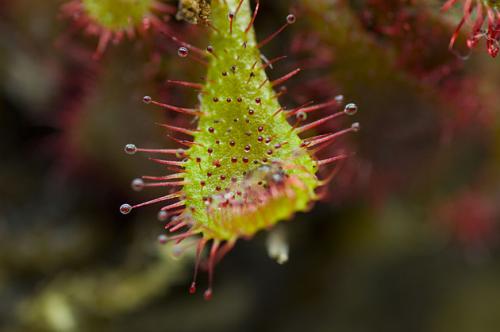
Sundew: the sundew is distributed in the northern mountainous areas. The whole plant is roughly the size of a fifty-yuan coin, with an inconspicuous stem and leaves spreading out in all directions, lying flat on the ground, really like a small carpet spread on the ground!
Look closely, and the little carpet is covered with dense hairs, each tipped with a round drop of liquid that sparkles like dew when the sunlight shines on it. These glandular hairs are the sundew's secret weapon for catching insects! When an insect is attracted by the dew-like liquid and crawls onto it, it gets stuck in the sticky liquid and becomes a snack for the sundew.
Drosera: it also uses the glandular hairs on its leaves to stick to insects. However, the glandular hairs can only catch relatively small insects. The bladderwort is a small aquatic plant. Normally its body grows in the water, and only when it blooms does the flower stalk extend above the water surface. Looking at their slender appearance, it is hard to imagine that they too are carnivorous plants. The leaves of the bladderwort branch into thread-like forms and grow some bladders; the bladders have inward-opening flap lids, and once a small animal in the water crawls in, it is not easy to get out again, and so it becomes nutrients for the bladderwort!