Cultivation Techniques for Water Bamboo: Scientific Fertilization Based on Changes in Growth Characteristics
The growth and development of water bamboo shoots can be divided into four stages according to their characteristic changes. So how do you fertilize water bamboo?
1. Germination stage: When spring temperatures rise, tiller buds and ramet buds begin to sprout, successively forming new shoots. Generally, the upper buds sprout earlier than the lower buds, and their growth vigor is stronger.
2. Tillering stage: When the new plant has grown to have 5 leaves, tiller buds can develop in the leaf axils at its base. Each new plant can produce about 10~20 new tiller buds, of which only the new buds from early tillering can develop into enlarged tender shoots, which are called effective tillers.
3. Shoot-forming stage: This is the period when the base of the stem begins to expand.
4. Dormancy stage: When the temperature drops below 150C, aboveground growth stops. At this time, tiller buds form on each shortened stem, and ramet buds form from the underground stems produced by new shoots; both remain dormant in the soil.
Formation of Water Bamboo Shoots
When the young bud forms, the hyphae of the smut fungus invade, and microscopic observation of sections reveals that the hyphae are distributed throughout the entire tissue. The hyphae sustain growth using nutrients from the host and expand to form fungal cavities; the hyphae secrete plant hormones, inducing abnormal cambium, promoting cell division, and causing abnormal cell enlargement to form water bamboo shoots, after which the smut fungus then produces thick-walled spores. Research shows that the auxin IAA content in the stems of flowering plants is 3~4 times less than in the shoots during the shoot-forming stage.
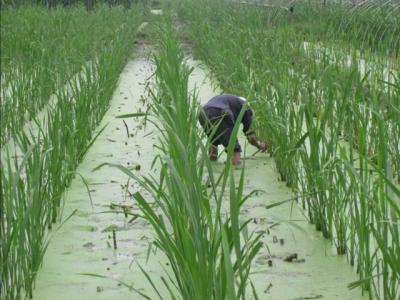
Recommended Fertilizer Rates and Application Methods for Water Bamboo Shoots
(1) Recommended rates of the three major elements (kg/ha): Single-season water bamboo (Red Shell variety): nitrogen 100-150. Phosphoric anhydride: 80-100. Potassium oxide: 50-100.
(2) Recommended compost rate: 15-20 metric tons/ha.
(3) Fertilization timing and methods (kg/ha)
1. Base fertilizer: Before land preparation, apply the full amount of compost and 400 kg of superphosphate (containing 72 kg of phosphoric anhydride), broadcast over the entire area, then plow into the soil and mix thoroughly with the soil.
2. First topdressing (10-15 days after planting): Apply 35-55 kg of urea (containing about 15-23 kg of nitrogen) and 50-100 kg of potassium chloride (containing 30-60 kg of potassium oxide).
3. Second topdressing (20-25 days after planting): Apply 55-85 kg of urea (containing about 25-38 kg of nitrogen) and 110-140 kg of superphosphate (containing 20-25 kg of phosphoric anhydride).
4. Third topdressing (shoot-forming stage when the pseudostem becomes flattened and enlarged): Apply 55-85 kg of urea (containing about 25-38 kg of nitrogen) and 33-66 kg of potassium chloride (containing 20-40 kg of potassium oxide).
5. Fourth topdressing (during the autumn water bamboo harvest period): Apply 85-125 kg of urea (containing about 36-53 kg of nitrogen).