Tobacco Planting Time and Seedbed Management Techniques
Tobacco is widely grown in our country, so do you want to grow tobacco? Would you like to learn how to grow tobacco?
Tobacco seedling raising: tobacco seeds are very small, and from sowing to the seedling stage they are easily damaged by environmental influences, so a seedbed should be set up and carefully managed to cultivate strong tobacco seedlings.
(1) Selection of the seedbed site
1. It is best to choose a place with convenient irrigation, ample sunlight, and no exposure to strong winds.
2. The soil is best if it is a well-drained sandy loam.
3. Choose a field where tobacco or other solanaceous plants have not been grown for 2-3 years,
so as to avoid transmitting pests and diseases.
(2) Preparation of the seedbed
1. Tobacco seeds are small, so land preparation should be finer; about two weeks before sowing, plow and disinfect the soil.
2. After land preparation, make beds; the bed width is 1-1.2 m, the distance between beds is 45 cm, and the bed height is 10 cm. Each hectare of field generally requires about 50 ping of seedbed.
3. Each ping of seedbed needs to be evenly covered with fertilized soil, that is, 700 g of compound fertilizer Taifei No. 36 (7-21-21) mixed with 20 kg of fine compost and fermented, and after one week mixed with 20 kg of fine soil to make fertilized soil. After applying the fertilized soil, level and press it lightly, water thoroughly and moisten it, and then sow.
(3) Sowing
1. Suitable sowing period: late August to early September.
2. Sowing rate: about 0.5 g of seed per ping for a direct-seeded seedbed, and about 0.8 g of seed per ping for a seedbed used for transplanting.
3. Sowing method: use the broadcast sowing method; fully mix a measured amount of seed with an appropriate amount of fine compost in a container, thenspread it evenly over the bed surface, and finally cover it with a little rice straw to avoid direct sunlight and maintain moisture.
(4) Seedbed management
1. Water management: after sowing, water once in the morning and once in the evening; one week after germination, reduce the number of waterings and increase the amount of water.
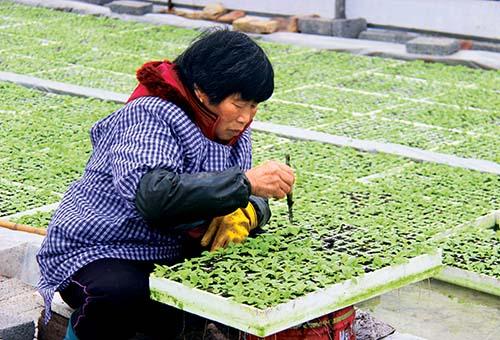
2. Thinning and weeding: after the seeds germinate, because the spacing is uneven they tend to grow leggy and are prone to pests and diseases, so tweezers are needed to remove overly dense and poorly growing tobacco seedlings; this is called thinning (Figure 5-2-2). Thinning can be done together with pulling weeds, and it is best carried out in 2-3 rounds; for direct-seeded seedbeds keep a distance of 5-7 cm between seedlings, and if transplanting is needed, the seedling spacing is about 2-3 cm.
3. Applying topdressing: for direct-seeded seedling raising, if it is washed by heavy rain, an appropriate amount of topdressing should be added again. For transplanting seedling raising, topdressing is not necessary.
4. Direct seeding and transplanting
Direct-seeded seedling raising saves labor and can reduce the chance of spread of viral disease; but transplanting seedling raising can promote root development, make tobacco seedlings grow strong and uniform, increase the survival rate after transplanting, and make management convenient. At present, this province mostly uses the transplanting method.
Transplanting is best carried out about two weeks after sowing and germination, when the largest leaf of the tobacco seedling is about 2 cm and the spacing of transplanted seedlings is about 6-8 cm. Before transplanting, wash hands with soap to prevent the spread of viral disease; to promote survival, it is best to transplant after 4 p.m.