Why is the green sea turtle called a living fossil of the animal kingdom, and what are its main characteristics?
The green sea turtle belongs to the family Cheloniidae, genus Chelonia. It is distributed around the poles, with traces found in sea areas from 35 degrees north latitude to 35 degrees south latitude, but it is mainly distributed in tropical to subtropical sea areas. What is its body shape like? What kind of characteristics does it have? Let's take a look together.
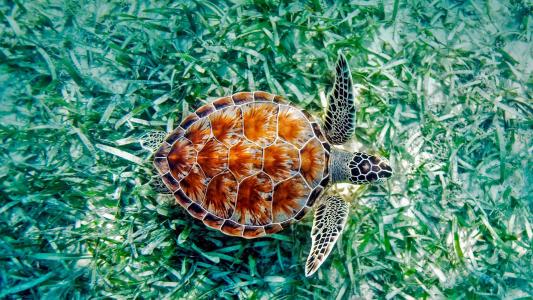
Its body shape is a long oval, the carapace has four pairs of lateral scutes, and five central scutes arranged in a tile-like pattern without overlapping each other. The body color ranges from brown to ink black, and sometimes the carapace has large mottled markings. The straight carapace length of an adult green sea turtle can reach more than 1 m, and its weight can reach more than 100 kg.
The green sea turtle is one of the most numerous species among all sea turtles at present, with the global population estimated at more than 200,000, but most are distributed in a few areas, and apart from a very small number of areas where numbers have increased due to successful conservation, sea turtle populations in most areas are declining, and nesting sites are also continuously disappearing.
Sea turtles are living fossils in the animal kingdom, first appearing 200 million years ago in the Triassic Period, appearing at the same time as dinosaurs. The ancestors of sea turtles were freshwater turtles, which gradually moved from land into the ocean during evolution; at that time, their flippers and the toes on the flippers were very similar to those of present-day freshwater turtles, but because they have salt-secreting lacrimal glands below the eyes, they were able to adapt to life in the sea.
There are seven species of sea turtles existing worldwide. Early sea turtles diverged into four different types, among which two became extinct because they could not feed effectively, and the third appeared about 110 million years ago, among which only the leatherback turtle, because it preyed on the most abundant food in the sea at that time——planktonic jellyfish, became the only species that survived.