How to Treat a Centipede Bite? Learn About the Effects and Uses of the Chinese Medicine Centipede
Centipedes are venomous, so what should you do if you are bitten by one? What are the effects and uses of the Chinese medicine centipede?
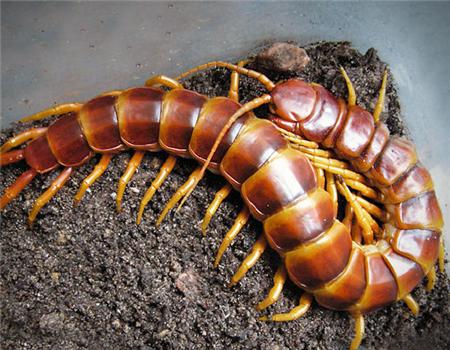
The centipede is also called the hundred-legged worm. In biology, centipedes in the broad sense refer to the Chilopoda among arthropods, which includes house centipedes, centipedes, stone centipedes and earth centipedes, and each of their body segments has 1 pair of legs. Among the Chilopoda, only some earth centipedes are truly hundred-legged; the other types do not have 100 legs. House centipedes and stone centipedes have only 15 pairs of legs, while centipedes come in two types with 21 or 23 pairs of legs, but the legs of earth centipedes vary greatly, ranging from 31 pairs to 181 pairs.
Although earth centipedes have the most legs, this does not make them walk faster; on the contrary, they walk the slowest, because their legs are the shortest and they move like earthworms. The house centipede differs greatly in appearance from other centipedes and instead looks like a sea cockroach; its 15 pairs of legs are all very long, exceeding the length of its body, and it runs the fastest. In addition, many people do not know that centipedes are not insects; insects have only 3 pairs of legs.
Below the head, the centipede has 1 pair of venomous claws evolved from legs. They are carnivorous animals and will first grab prey with the legs at the front of the body, then pierce the prey's body with the venomous claws, injecting venom to kill the prey. In fact, centipede venom is similar to bee venom: it causes pain but is not fatal, and most centipedes are small and have little venom. If you are bitten, the best approach is to clean and disinfect the wound; applying ice can reduce local swelling and pain, and the pain disappears after a few days and it heals. A small number of people will have more severe symptoms, such as redness and swelling or swollen lymph nodes; this is a bacterial infection of the wound, and they should seek medical attention immediately.
We often hear people speak of fighting poison with poison, and over time we take it for granted without asking whether "fighting poison with poison" is reasonable, or what the theoretical basis for it is. The Compendium of Materia Medica records that the centipede has the effects of "calming wind and stopping spasms, and attacking toxins and dissipating masses." The centipede used in Chinese medicine is the large centipede with a red head and red legs; a bamboo sliver is pierced through its head and tail, it is stretched straight and sun-dried, and it is used raw or dried over heat and ground into powder for oral use. But I do not recommend taking it, because the theory recorded in ancient books for the centipede's therapeutic effect is that the fastest things in the world are wind and snakes, and the centipede can overcome snakes, and therefore can also overcome wind, so it can treat acute infantile convulsions, stroke, spasms and snake bites. I have seen some people steep venomous creatures such as snakes, centipedes and tiger-headed wasps in liquor and drink it, believing that the more venomous it is, the more nourishing; however, this kind of folk remedy is very dangerous, and after taking it, it may cause liver and kidney damage, and may even require dialysis.
Centipedes and millipedes are myriapods. The millipede is also called the thousand-legged worm, and except for its first three segments, which each have one pair of legs, every other body segment has two pairs of legs. Its role in the ecosystem is that of a detritivore, feeding on decaying plants. The so-called five poisons is the folk collective name for five venomous animals: the scorpion, snake, centipede, gecko and toad, but in fact the gecko is not venomous, so there is also a version in which the spider replaces the gecko to become one of the five poisons.