Why honeysuckle leaves curl downward and how to fix it
What is going on when honeysuckle leaves curl? What can be done? Let's take a look.
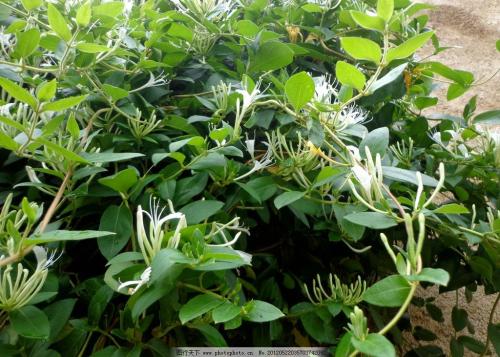
1. Pest control not timely: aphids appeared and were not sprayed in time; aphids can be prevented with a small dose, and the plant will not be burned by spraying, so the dose does not need to be large;
2. Insufficient water: when it was taken, there were too many branches and leaves; abundant branches and leaves need a large amount of water, and because it is a newly transplanted sapling, the many branches and leaves lead to an insufficient water supply;
3. Soil does not retain water: after planting, the soil around the roots may not have been firmed down, making the root-zone soil loose and prone to water shortage; your area in Gansu is relatively dry. Wind and sand should not be the main cause, but frequent wind easily makes the soil drier. Honeysuckle does not have high demands for soil texture and nutrients, and newly planted seedlings may not be able to absorb them even if base fertilizer was applied. It is suggested to appropriately prune the branches and leaves, especially those that have already dried up and died, but do not prune too much; removing dead branches is enough. You can firm down the soil.
After discovering the problem, it is suggested to improve the flower pot and potting soil:
1. Growing medium: although honeysuckle is not strict about soil, growing it in a mix of 60%-70% peat, 20%-30% vermiculite and 10% perlite as potting soil will make the plant grow better.
2. Water and fertilizer management: during the 3 months before flowering, apply a fertilizer mainly of phosphorus and potassium 1-2 times. After the flowers fade in late May, a light fertilizer should still be applied 1-2 times, and the new shoot tips should be appropriately pinched to promote the sprouting of a second batch of flower buds. At the same time, keep the soil moist and avoid excessive dryness, otherwise the basal leaves are prone to turning yellow and dropping and flowering will be affected. In hot seasons, avoid direct strong light to prevent burning the tender leaves.
3. Shaping and pruning: during its dormancy, prune once, removing slender branches, weak branches and crossing branches, and shorten the current year's branches, so as to help produce new branches and more flowers the following year.
4. Pest and disease control: honeysuckle has relatively few pests and diseases, with occasional aphid attacks that harm new leaves and tender shoots, causing leaves to curl and affecting growth; simply use "Yashibi" at 1000 times dilution or other insecticides for control.