Can orchids be kept on a balcony? Care requires extra effort
Most flower enthusiasts want to grow orchids, but nowadays everyone lives in apartment buildings, and the only space for plants is the balcony, so people ask: can orchids be kept on a balcony? Actually, yes, and the vast majority of enthusiasts grow their orchids on balconies, and they have summed up a lot of experience!
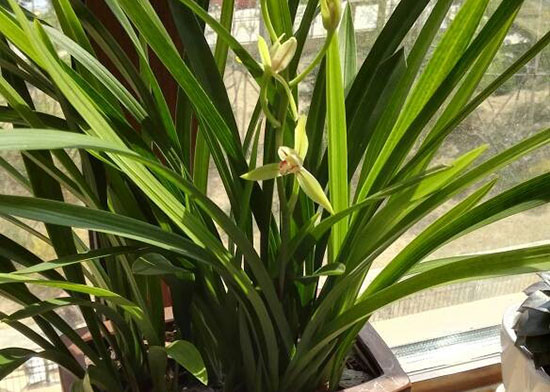
I. Characteristics of different balcony environments
1. Characteristics of an open balcony: good ventilation, good light, large temperature difference (high temperatures in summer), low humidity, dry, strong transpiration;
2. Characteristics of an enclosed balcony: average ventilation, good light, average temperature difference (high temperatures in summer), low humidity, dry, strong transpiration;
II. Temperature, ventilation, humidity
1. According to numerous sources, around 28°C is the optimal growth temperature, while above 35°C growth slows or the plant goes dormant. Based on my observations over the past few years, orchids are still growing at 37°C. Perhaps what everyone worries about more is that high temperatures easily lead to the occurrence of the two rots. The occurrence of the two rots is not only related to high temperature, but also to light, potting medium, watering and ventilation management. Reasonable light, clean, well-draining and breathable potting medium, and a good ventilation environment and management can prevent the occurrence of the two rots. This requires a combination of these factors, and it really cannot be explained clearly in just a few words. Here I am only saying that everyone should not focus solely on temperature. Temperature is only one triggering factor, but in summer a well-ventilated environment plays a role in preventing the two rots with twice the result for half the effort, so ventilation is very important. You must ventilate, ventilate, ventilate, and open all the windows that can be opened!
2. Having good humidity is beneficial for sprouting and growth, but it cannot be one-sidedly understood as the higher the humidity the better. Humidity that is too low, below 35%, and above 65% is not necessarily good humidity (everyone understands whether high-temperature and high-humidity plants are good). As humidity rises, it becomes more favorable for mold reproduction, and when it is above 65% it is even more favorable for mold reproduction. Under natural balcony cultivation conditions, 1. it is very difficult to solve low humidity; 2. low humidity during the day and high humidity at night is a natural humidity difference, so during the sprouting period we can (when the temperature has just started to rise (late spring and early summer)) open the windows for ventilation during the day and close the windows at night to raise humidity; during the growth period (summer) this cannot be done. There is no need to care too much about low humidity. Low humidity just makes the leaf color look dry and not so pretty, and growth a bit slower, but what is the big deal about that.
III. Light and shading
"Sun cultivates the plant, shade cultivates the flower." Some people will ask whether I have it backwards, since books all say "shade cultivates the plant, sun cultivates the flower." I have not reversed it. What the books say is that under good light conditions it is easy to produce flowers, and under weaker light conditions the orchid leaves are tender green in color and look very beautiful, but the leaf texture is thin and soft; what I am saying is that under good light conditions, although the leaf color is not so tender green and looks oily green, the leaf texture is thick and hard, and the plant's resistance is also good. Under weaker light conditions, when cultivating flowers, the flower color and flower quality are better.
I like sun cultivation. In spring, late autumn and winter I use full light. In summer shading is needed. I use aluminum blinds. After adjusting the angle, sunlight after 9 a.m. cannot shine into the balcony. While shading, it also ensures maximum ventilation.
IV. Potting medium, pots
As long as the potting medium has "cleanliness, drainage and breathability, a certain amount of nutrients and water retention," it is fine. Hard materials or fine materials can be adjusted according to your own actual situation. For balcony cultivation, if you are growing a relatively large number, I suggest using plastic pots: first, they are uniform and easy to manage; second, they are lightweight. When using black plastic pots in summer, prevent direct sunlight from hitting the pot body, because then the pot temperature will be very high, which is also a trigger for rot disease. You can wrap the sun-facing side of the pot with white paper.
V. About the pot surface
Some people like to use hard materials (Kanuma soil, calcined clay, etc.) to cover the pot surface, while others like to use sphagnum moss to cover the pot surface (I belong to this group). As for what to use for covering, there is no absolute good or bad; it comes from each person's environment and management. Some people say that covering with sphagnum moss will definitely cause rot, but I have not seen many pots rot. On this point, do not use personal preference to affirm or deny, but rather think and understand why others do it this way. Then again, in the whole process of growing orchids, which step is not like this? If everyone just goes by their own likes and dislikes and does not think about why it should be done this way, then they will certainly stagnate, and it may be very difficult to grow your orchids well.
VI. Pest control, sterilization
I personally seldom sterilize (only once in early summer each year). I think that while killing harmful bacteria, beneficial bacteria are also killed. Then someone will say, if you do not sterilize, what about the two rots? 1. Bacteria are only one factor in the occurrence of the two rots, not all of it; 2. Not only medicine can sterilize. Can sunlight and water not sterilize? Pest control is very important, especially snails (they can make a year or even several years of your work go to waste). Pest control is needed in late spring and early summer and in autumn. Generally, once a month is enough for me.
VII. Watering
Here there is dry cultivation (the traditional method), wet cultivation, and some people have also proposed moist cultivation. In any case, most beginners' orchids die from drying out.