What do beet armyworm larvae and adults look like? A detailed breakdown of their morphological features
We know that the beet armyworm is a pest, but do you understand its ecological habits and morphology? Let's take a look together.
Ecological habits: The adult beet armyworm hides by day and comes out at night, resting on the undersides of leaves or in dark places during the day, and beginning activity and mating after sunset. After mating, it begins laying eggs after 1 to 4 days; the egg-laying period lasts 1 to 10 days, and each female lays 205 to 508 eggs, averaging 300. The egg masses are irregular, usually in clusters of 30 to 80 eggs, covered with the female's body hairs, and laid on the undersides of the plant's leaves. The egg stage lasts 2 to 6 days. The larvae have 5 instars, often hiding during the day in cool places such as near the ground or among soil particles on the soil surface, and active and feeding at night. The larvae are cannibalistic. They are most numerous in spring and autumn, especially during droughts when population density is higher. The larval stage lasts 10 to 56 days. Mature larvae drop to the ground and pupate in the soil or in fallen leaves or debris on the soil surface. The prepupal stage lasts 1 to 2 days, and the pupal stage 5 to 16 days. This insect can have more than ten generations per year.
Morphology:
Egg: Pale yellow, round, with radial raised lines, about 0.5 to 0.6 mm in diameter.
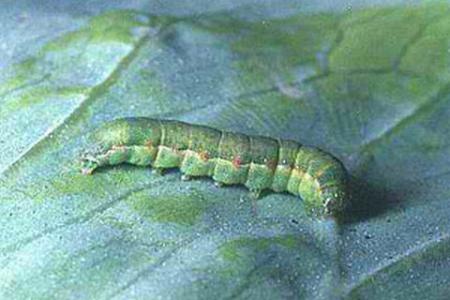
Larva: Body color varies greatly, pale yellow-green or dark brown, sometimes yellowish white; the dorsal line is distinct, and the subspiracular line is white; body length is about 35 to 40 mm.
Pupa: Reddish brown, pale green when newly pupated, spindle-shaped, with two tail spines at the end; body length is about 11 mm.
Adult: There is a tuft of hair at the base of the dorsal side of the abdomen; the body and wings are grayish brown. On the sides of the labial palps and the hair tufts on the back of the abdomen, the color is dark brown. The inner and outer transverse lines of the forewings each have two dark brown fine streaks, and the median transverse line is also brown; at the ends of the three transverse lines on the leading edge there are two small dark brown spots each; the orbicular stigma and reniform stigma are grayish yellow, with fine black outlines and orange-brown centers; the submarginal line is an indistinct pale color, the inner and outer shades are slightly dark, and the outer margin has black dots. The base of the fringe is dark, with white tips; the hindwings are white, with the leading edge and outer margin slightly tinged with dark brown. The outer margin line is dark brown. Body length is about 11 mm, and wingspan is about 25 to 30 mm.