Orchid growth and development: temperature requirements and physiological manifestations
Orchid growth and development: temperature requirements and physiological manifestations
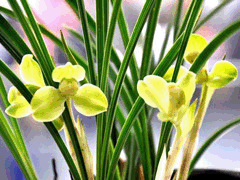 Orchids, like other plants, their production and development are closely related to temperature levels. From a physiological perspective,orchidshave a critical growth and development temperature of -10 degrees, a starting temperature of 16-18 degrees, and an optimal growth temperature of 18-28 degrees. That is to say, when the daily average temperature is below 10°C,orchidsstop growing; between 10-16°C, orchids basically stop growing; when the temperature stabilizes above 16-18 degrees, orchids enter normal growth and development.
Below the critical temperature (10 degrees), orchids absorb basically no nutrients except for a small amount of water, respiration is noticeably weakened, photosynthesis capacity is greatly reduced, nutrients in the body are in a gelatinous state, and they rely on organic matter stored in the pseudobulbs to maintain life activities. Orchids are basically in a dormant state.
Between the critical and starting temperatures (1-16 degrees), orchids are in a semi-dormant state, root fertilizer absorption capacity is weak, and a certain water supply is needed. Nutrients in the body are in a semi-colloidal state, and the transport capacity of conductive tissues such as vessels and sieve tubes is very weak. Respiration is closely related to temperature level, showing a positive proportional trend. The energy consumed by respiration greatly exceeds the energy produced by photosynthesis. The longer the "warm winter" period (10-16°C), the more accumulated nutrients in the orchid body are consumed, and the greater the contradiction of "no input," making orchids' cold resistance and stress resistance weaker. (Wu Zongbin)