Hard Growing Media Cultivation Method: Experience Shared by Minnan Dahai
Minnan Dahai's Hard Growing Media Cultivation
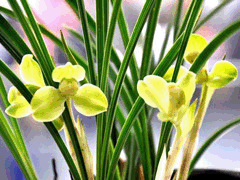 Minnan Damei was discovered in the forest region of Nanjing, Fujian ProvinceCymbidium sinensenew variety. Semi-upright leaf type, medium height. Leaf color emerald green, lustrous, with an elegant plant form. Its blooming period coincides with the Spring Festival, with 8-15 flowers per scape, true plum blossom petal type, held above the leaves, fragrant. It has won gold awards at national orchid exhibitions multiple times and was registered in March 2002. It is currently the highest-gradeCymbidium sinenseplum petal flower.
Although Minnan Damei is of high grade, its root system is thick and strong, making it relatively easy tocultivate. In recent years we have used hard growing media to plant Minnan Damei, and the plants are tall and robust, with a sprouting rate reaching 150%.
I. Choosing good pots and growing media is the foundation
At first, we used mountain topsoil as growing media and planted the newly collected Minnan Damei in tall cylindrical clay pots for domestication. The growth was acceptable. But the sprouting rate was relatively low, and the leaves and plant form were not ideal either. Later we accepted the suggestion of Taiwanese orchid growers and used black plasticorchidspecial-purpose pots (No. 4 and No. 5) as containers. This type of orchid pot has adequate drainage and ventilation holes from the bottom to the walls, ensuring the orchid roots' requirement for ventilation and air permeability. The growing media used 85% charcoal kiln granules (that is, the kiln wall soil discarded from charcoal burning in forest regions), mixed with 15% fern rhizome segments 3-5 cm long. This soil, after long high-temperature calcination, hardens into blocks; when broken into granules of 0.6-1.5 cm diameter, it has the characteristics of solid texture and not dissolving in water. The cultivation results were satisfying.
However, because charcoal kiln soil granule resources are limited and increasingly depleted, we again referred to the experience of Taiwanese orchid growers using hard growing media for orchids and used inexpensive, abundantly available small pebbles instead. Specific formula: 70% fresh small pebbles of 0.8-1.2 cm diameter, plus 15% medium-coarse granular pond foundation stone, plus 15% fern rhizome segments, mixed evenly. Years of practice have proven that this growing media formula is entirely feasible. Because small pebbles are hard and smooth, they benefit orchid seedling growth, but their water absorption is poor; pond foundation stone is soft in texture with large gaps and strong water absorption, which also benefits ventilation; fern rhizome can increase the gaps between growing media, creating a softer environment for orchid seedling root growth. Orchid seedlings cultivated with this growing media have thick and solid root systems, do not easily lose water after being removed from the pot, and are easy to bag and adapt for long-distance storage and transport or mailing.
II. Ensuring nutrient supply is the key
Because hard granular materials are used as growing media, the substrate nutrients are relatively poor, so how to ensure the plant's nutrient requirements is especially important. We solve this by applying high-efficiency slow-release quality compound fertilizer. Specific method: when planting orchid seedlings and filling the growing media, apply about 5 grams (10-15 granules) of Magic Fertilizer per pot, then apply another topdressing after half a year. In this way, as long as the growing media contains the corresponding moisture, the orchid roots can absorb the needed nutrients. Of course, some supplementary measures are also needed, namely spraying a 1500-2000 times diluted Huabao foliar fertilizer once a week (choose the appropriate model according to the different growth stages of the orchid seedlings), and applying organic fertilizer once each in spring and autumn. This can fully satisfy the fertilizer requirement for one year of orchid plant growth. Because Magic Fertilizer is a high-phosphorus, high-magnesium compound fertilizer, it has the effect of promoting early sprouting, fast root growth, and enhancing orchid plant resistance, and is especially suitable for planting high-gradeorchids.
III. Water management must not be relaxed
Minnan Damei, like otherCymbidium sinense, is a moisture-loving orchid type. Its leaves are wide and thick, and leaf surface evaporation is relatively large. And hard growing media has relatively poor water absorption and retention, so watering should be relatively frequent. In hot summer, insist on watering once a day; in spring and autumn, water once every 2-4 days; in winter, watering once every 5-6 days is enough.
IV. Shade measures must keep up
Minnan Damei is a sun-loving orchid type, so the orchid room should be equipped with two layers of shade netting. The top layer has a shading rate of 75%-80%, installed on the outdoor roof for fixed shading. The lower layer has a shading rate of 60%-75%, installed indoors and adjustable. In hot summer, both layers are used simultaneously; in winter or on cloudy and rainy days, the lower layer is retracted. This can both satisfy the orchid plant's photosynthesis needs and avoid strong light burning the orchid seedlings. (Fujian / Liu Zhenlong)