What is "Bailasi"? One article to help you get to know it anew
A Fresh Look at "Bailasi"
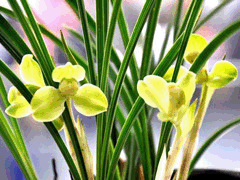 Many orchid growers knoworchidsthat coming down with "Bailasi" produces disease spots, and in severe cases leads toorchiddeath, but orchid growers who truly understand the essence of the "Bailasi" disease may not be many. Here I would like to use simple language to introduce these orchid growers to the "theoretical issues" of "Bailasi". I believe theory will be useful in guiding practical work (growingorchidswell and preventing and controlling "Bailasi").
"Bailasi" is a transliteration of a foreign term; outside the Chinese orchid world it is rarely used, and the more common name is "virus". Plants can suffer from all kinds of diseases, and in classification these can be divided into two major categories: "biotic" and "abiotic"; "biotic" can further be divided into three subcategories: "bacteria", "fungi" (the kind that goes moldy) and "viruses" (pests such as nematodes cause external wounds to plants, but that is not a disease). Because there are many kinds of bacteria, fungi and viruses, the types oforchiddiseases are also very many, and prevention and control often require different methods, for example using different pesticides. But for viral diseases, almost no pesticide is effective; this is the distinctly different and frightening characteristic of viral diseases compared with bacterial and fungal diseases, and this characteristic is precisely caused by the nature of viruses.
A virus is a very special organism, and its greatest difference from bacteria, fungi and many other organisms is this: a virus is a "molecular organism" rather than a "cellular organism". Viruses parasitize the living cells of other organisms (for example, orchids), using the "energy, tools and materials" within the living cells to reproduce themselves, and under suitable conditions they can reproduce faster than any other organism. Therefore, a virus is also a "parasitic organism". The reason pesticides find it hard to act on viral diseases is that it is difficult for pesticides to avoid being toxic to the plant's cells while being able to kill (in academic terms, "degrade") the virus inside the cells.
Because of the parasitic nature of viruses, they affect the life of the cells they parasitize (the appearance of spots on leaves is one manifestation), and in severe cases lead to the death of the cells.
Some people call viral diseases "toxin diseases"; this way of speaking is incorrect, because viruses do not produce toxins throughout their entire life and reproduction process; on the contrary, it is bacteria and fungi that produce toxins. Secondly, calling viruses "toxins" is also incorrect, because the meaning of the word "su" (element) is "a substance without life", whereas viruses are alive, and being able to use external conditions for their own proliferation is the concrete embodiment of a living organism.